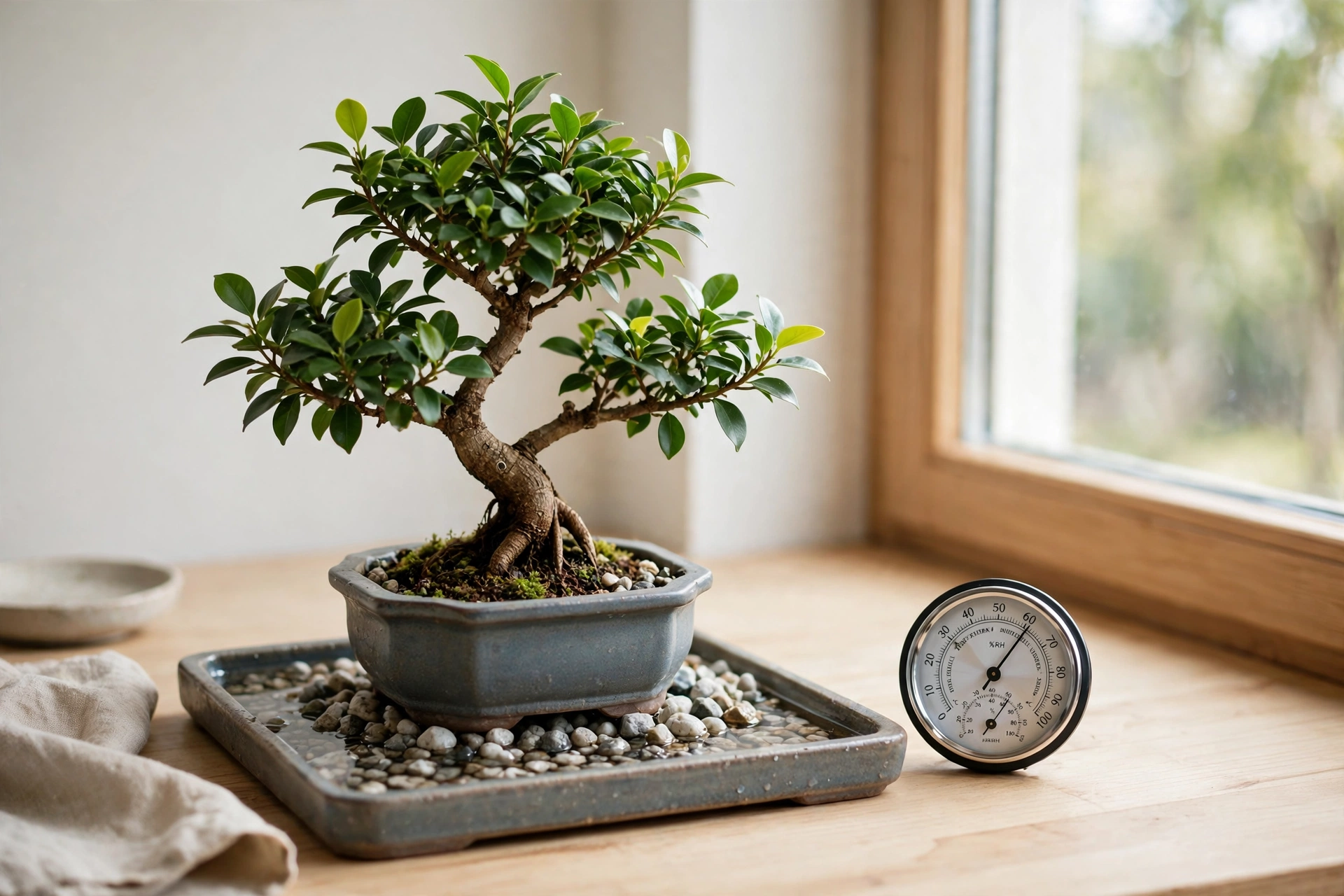
If your indoor bonsai has dry leaf tips, unexplained leaf drop, or weak new growth, low humidity may be part of the problem. Learning how to improve humidity for indoor bonsai trees is one of the most useful skills for anyone growing tropical or subtropical species inside, because heated and air-conditioned rooms are often much drier than the air those trees evolved to grow in.
A few practical changes, measured with a hygrometer, can bring the air around your tree much closer to what it needs — though humidity cannot replace suitable light, careful watering, or healthy roots.
What Humidity Means for an Indoor Bonsai
Humidity is the amount of water vapor in the air, usually described as relative humidity: the percentage of moisture the air holds compared with the maximum it could hold at that temperature. Warm air can hold more water vapor than cold air, which is why heated indoor air often feels dry in winter.
A bonsai loses water through tiny pores in its leaves called stomata. When the air is dry, water leaves the foliage more quickly, and the tree must pull more water from its roots to keep up. If the roots cannot keep up, leaf edges dry out. Needs are species-specific: a ficus or Fukien tea kept indoors may appreciate more humid air, while a juniper or pine belongs outdoors in most climates.
How Much Humidity Do Indoor Bonsai Need?
There is no single humidity level that suits every indoor bonsai. Tropical and subtropical species generally prefer moderately humid air, and many growers aim for roughly 40 to 60 percent relative humidity. Some humidity-loving species may prefer the higher end of that range, while hardier tropical species can tolerate lower levels if their light and watering are otherwise good.
Rather than chasing a precise number, aim for a comfortable, stable range. Sudden swings can stress a tree, and very humid, still air can encourage fungal problems and slow soil drying, so good airflow matters alongside humidity.
How to Tell If Your Indoor Air Is Too Dry
Dry air does not always announce itself clearly, and its symptoms can look like other problems, so check the air itself before assuming humidity is the cause. A small digital hygrometer placed near your bonsai, at foliage height, will tell you far more than guesswork. Leave it in place for a few days and note readings at different times of day.
Signs that may suggest low humidity include dry, brown, or crispy leaf edges and tips; leaves that feel papery or curl slightly inward; increased leaf drop after moving the tree indoors or when heating starts; and unusually fast-drying soil. None of these proves low humidity on its own — brown tips can also come from underwatering, overfertilizing, salt buildup, or cold drafts. If the hygrometer shows consistently dry air, humidity is a reasonable place to focus.
Indoor Heating and Air Conditioning: Why They Dry the Air
Heating and air conditioning are the two biggest reasons indoor air becomes dry. In winter, central heating warms cold outdoor air and the relative humidity drops, especially in rooms with radiators, forced-air heating, or wood stoves. In summer, air conditioning cools warm air and removes moisture from it.
The effect is strongest near the sources themselves: a bonsai above a radiator, beside a heating vent, or in the path of an air-conditioning outlet experiences drier, more changeable air than a tree a few feet away. Moving the tree away from direct heat and cold drafts is often the simplest first step, so set up your humidity measures before the heating season begins.
Humidity Trays: How They Work and Their Limits
A humidity tray, sometimes called a pebble tray, is a shallow tray of pebbles and water, with the bonsai pot sitting on top of the pebbles, above the waterline. As the water evaporates, it raises the humidity in the air immediately around the tree. Trays are cheap and simple, and they catch drips after watering.
A tray can help, but its effect is modest and local: it raises humidity mainly in the few inches of air directly above it, and the benefit fades quickly with distance and airflow. Choose a tray slightly wider than the pot, fill it with clean pebbles and water just below the top of the pebbles, and set the pot on the pebbles so the drainage holes stay above the water — never in standing water. If your hygrometer still shows very dry air, you will need a stronger measure, such as a humidifier.
Grouping Plants and Using a Room Humidifier
Grouping several houseplants together is a simple, free way to raise humidity in a small area: plants release water vapor through their leaves, a process called transpiration, and a group creates a slightly more humid pocket of air than a single plant alone. Place your bonsai with other plants that like similar light, leaving space between pots for air to move; tight crowding can encourage fungal problems.
For most indoor bonsai owners with genuinely dry air, however, a room humidifier is the most effective option: it adds water vapor directly to the room air, raising humidity across a meaningful area rather than just above a tray. Choose one sized for the room, aim for the moderate range your species prefers, and clean it regularly. More humid air can slow evaporation from the soil, so check soil moisture before watering.
Misting: A Common Misconception
Misting, or spraying a fine mist over the foliage, is one of the most commonly suggested humidity fixes, and also one of the most misunderstood. It does raise humidity around the leaves, but only for a very short time: once the droplets evaporate, usually within minutes, the air returns to its previous dryness. Keeping humidity up by misting alone would mean misting almost constantly.
Misting is not useless — it can clean dust from leaves — but it should not be your main humidity strategy, since wet foliage that stays wet can encourage fungal leaf spots. If you do mist, keep it occasional and gentle, use room-temperature water, and mist in the morning so leaves dry during the day. Never mist as a substitute for watering the soil, or a tree showing signs of fungal disease.
Placement, Airflow, and Species Differences
First, move the tree away from heat sources and cold drafts: keep it out of the direct blast of radiators, heating vents, fireplaces, and air-conditioning outlets. A spot a few feet from a bright window is often better than a windowsill directly above a heater, and in winter, consider moving sensitive tropical species slightly back from cold glass at night.
Second, keep some gentle airflow: stagnant air encourages pests and fungal problems. A ceiling fan on low or a slightly open door is healthier than a sealed, stuffy room, but avoid strong, direct drafts. Third, remember that species differ. Ficus prefers moderate humidity and is adaptable; Fukien tea and serissa prefer more humid air and dislike sudden changes; jade and Portulacaria afra store water and tolerate drier air, so do not over-mist them. Check a dedicated care guide for your exact species.
How to Improve Humidity for Indoor Bonsai Trees Step by Step
Follow these steps over a week or two.
- Identify your species and confirm it is a tropical or subtropical type suited to indoor growing.
- Place a hygrometer near the foliage and record readings for several days.
- Move the tree away from radiators, heating vents, and air-conditioning outlets, and check it still gets enough light.
- Set up a humidity tray, keeping the pot above the waterline.
- Group the bonsai with other suitable plants, leaving space for airflow.
- If readings remain low, add a room humidifier and monitor the result for a week.
- Check soil moisture before each watering, and watch for fewer dry leaf tips, steadier growth, and less leaf drop over several weeks.
Making one change at a time helps you see what works.
Common Mistakes
- Relying on misting alone. Misting raises humidity for minutes, not hours — do not treat it as a strategy.
- Letting the pot sit in tray water. A pot standing in water can keep soil soggy and encourage root rot. It must sit on pebbles above the waterline.
- Chasing very high humidity. Aim for a moderate, stable range.
- Ignoring light and watering. Humidity does not replace suitable light, careful watering, or healthy roots.
- Forgetting to clean trays and humidifiers. Stagnant water and dirty equipment breed algae, mold, and bacteria. Clean them regularly.
- Treating all bonsai the same. A juniper that belongs outdoors and a ficus that lives indoors have very different needs.
Frequently Asked Questions
What is the best humidity level for indoor bonsai trees?
There is no single best level. Many tropical and subtropical indoor bonsai do well in moderately humid air, often around 40 to 60 percent relative humidity, but the ideal range depends on the species, season, and tree health. Use a hygrometer and aim for a stable moderate range.
Do humidity trays really work for bonsai?
Yes, but only locally. A tray raises humidity in the air directly above it, which helps a little in a sheltered spot, but it will not humidify a large, dry room. Treat it as a small improvement that works best alongside grouping, good placement, or a humidifier.
Is misting good for indoor bonsai?
Misting can clean leaves and briefly raise humidity, but the effect lasts only minutes, so it is not a reliable way to maintain humidity. Frequent misting can leave foliage wet and encourage fungal problems. Mist only occasionally, in the morning.
Should I buy a humidifier for my bonsai?
Yes, if your home is consistently dry, especially in winter, and you grow several tropical bonsai indoors. It is the most effective way to raise humidity across a room. Choose a size suited to the room, monitor with a hygrometer, and clean it regularly.
Can low humidity kill a bonsai?
Low humidity alone rarely kills a healthy tree quickly, but it can weaken it over time: dry air increases water loss from the leaves, causing dry tips, leaf drop, and slower growth. A tree already stressed by poor light, watering, or root trouble is more vulnerable.
Does grouping plants really increase humidity?
Yes, slightly, because plants release water vapor through their leaves. The effect is modest and local, similar to a humidity tray, and works best when plants are grouped loosely with space for air to move.
Conclusion
Improving humidity for indoor bonsai trees starts with understanding your species and measuring your air. A hygrometer, a well-placed humidity tray, thoughtful grouping, and a room humidifier when needed can make a real difference for tropical and subtropical species in dry seasons. Misting has only a brief effect, and no humidity measure can replace suitable light, careful watering, and healthy roots.
Start with simple steps: move the tree away from heat and drafts, set up a tray, and measure the result. Add a humidifier only if the readings show you need one. For your next step, read a species-specific guide for your tree, such as the ficus or Fukien tea care guides.