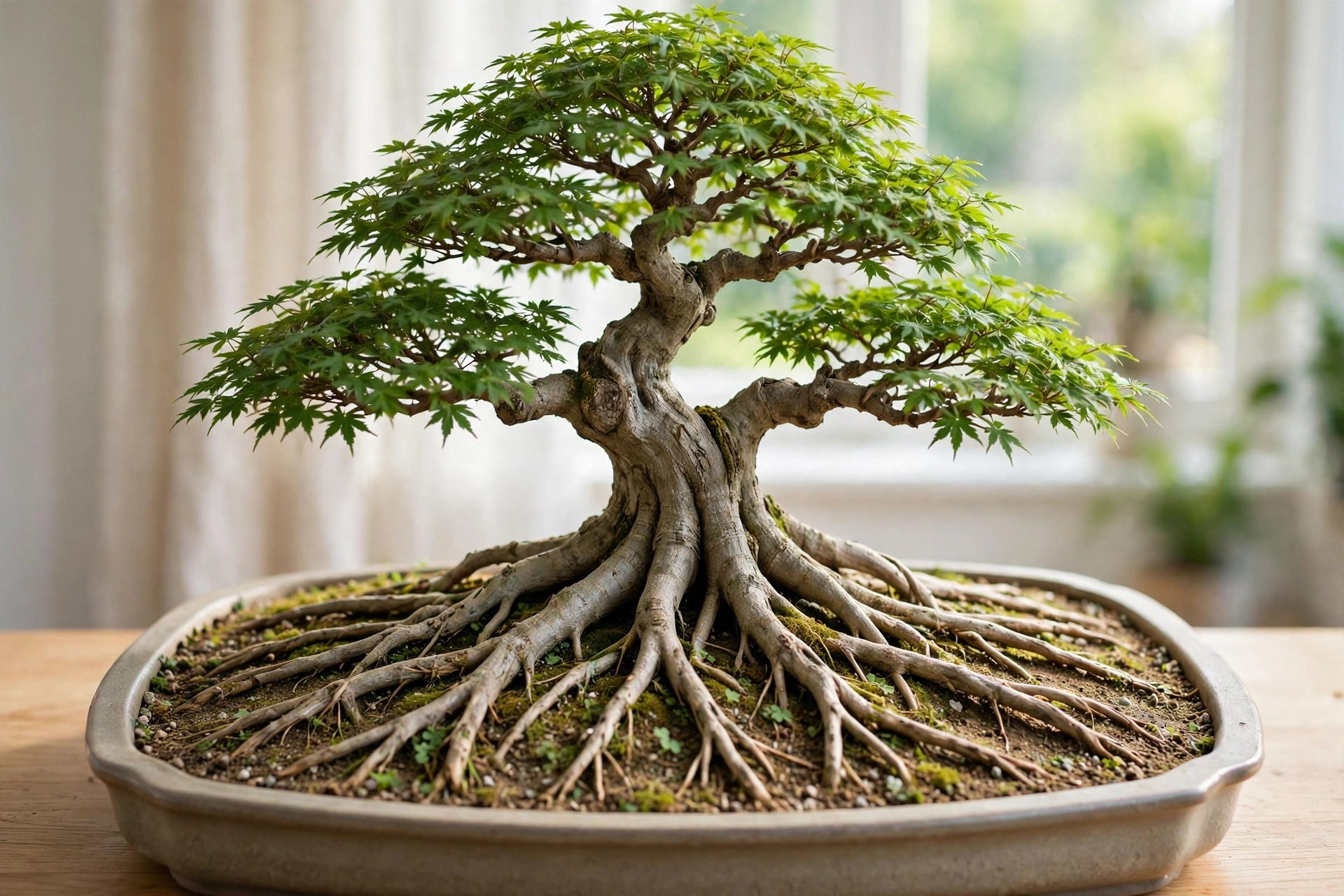
Bonsai nebari is the visible root flare at the base of a bonsai trunk, where the roots spread outward and grip the soil surface. A well-developed nebari makes a tree look stable, mature, and grounded, as if it has stood in the same place for many years. When the roots radiate evenly, the trunk appears wider and more powerful. Developing bonsai nebari takes patience and careful root work over several growing seasons; it cannot be forced in a single repotting. The principles are simple: encourage roots to grow outward, arrange them radially, protect the fine feeder roots, and expose the surface roots gradually.
What Is Bonsai Nebari?
Nebari is a Japanese term for the root flare and surface roots visible at the base of a bonsai. It describes the way the roots emerge from the trunk, spread across the soil, and anchor the tree visually as well as physically. In a mature tree in nature, the base of the trunk widens where it meets the ground, and the largest roots flare outward before disappearing into the soil. A good nebari is a balanced, radial spread of roots that supports the trunk from all sides, following its movement and taper rather than crossing over one another. It is judged as part of the whole tree, and the goal is harmony between roots, trunk, and foliage.
Why Nebari Matters in Bonsai Design
The base of a tree is the first thing a viewer notices, even if they do not realise it. A tree with no visible root flare can look as though it has been stuck into the soil like a post, while a tree with a strong nebari looks rooted and permanent. Bonsai nebari also communicates age: in nature, a wide root flare develops over decades as a tree grows and adapts to its site. Roots that spread outward also make better use of the available soil, but surface roots must never be developed at the expense of the fine feeder roots.
What Good Bonsai Nebari Looks Like
Good nebari shares several qualities, although the ideal varies with species, style, and tree size. The roots should spread radially, like the spokes of a wheel, with no large gap on one side. Each surface root should taper, being thickest near the trunk and gradually thinner as it extends outward. The roots should emerge from the trunk base and flow into the soil, rather than sitting on the surface like separate objects. They must not cross or girdle one another, because crossing roots can choke the roots beneath them. Finally, the nebari should suit the tree: a formal upright tree benefits from a symmetrical spread, while a slanting tree may have stronger roots on the side that balances the lean.
Radial Root Distribution: The Foundation of Nebari
Radial root distribution is the foundation of nebari development. It means arranging the main surface roots so that they leave the trunk at roughly even intervals around its full circumference, pointing outward in every direction, with no large empty sector. Roots that grow straight down, or that all grow to one side, do little for the visible base of the tree. A taproot, the single strong root that grows downward from a seedling, is particularly unhelpful: it takes energy and space that could go into lateral roots, and it makes the tree difficult to plant in a shallow pot. Many growers therefore remove or shorten the taproot early, when the tree can recover and produce new lateral roots. Do this only on a healthy, vigorous tree at the right time of year for the species.
Starting Early: Nebari Development in Young Trees
The best time to start developing nebari is when a tree is young. Seedlings, cuttings, and young nursery trees are flexible and vigorous, and they can produce new roots readily. Their root systems have not yet become fixed, so a grower can shape them with relatively small interventions. A tree that has spent many years in a pot with a tangled root system can still be improved, but progress is slower and the risks are greater. One common technique is to spread the young roots over a flat surface when the tree is first potted: some growers place a small flat tile beneath the root ball to discourage downward growth, while others plant the young tree on a mound of soil so that the roots flow outward. Work gently and keep the roots moist.
Repotting, Root Arrangement, Pot, and Soil
Repotting is the main opportunity to work on bonsai nebari, because it is the only time you can see the full root system and rearrange it. Always follow species-specific guidance and repot only when the tree is healthy and at the right time of year for that species. When you remove the tree from its pot, inspect the roots before cutting anything. Remove old soil from around the outer roots with a root hook, a chopstick, or your fingers, without tearing the fine roots. Spread the main roots outward to improve the bonsai root spread, look for gaps, and shorten roots that are too long for the pot, but do not remove too much root mass at once. If a root is crossing over another, remove the weaker one. Then place the tree at the correct height and angle, work fresh soil in around the roots with a chopstick, secure the tree with wire, and water thoroughly. A wide, shallow pot encourages lateral root growth, and the soil should be free-draining, typically based on akadama, pumice, and lava rock.
Gradual Exposure: Bringing Surface Roots into View
Once the roots are arranged radially, the next step is to expose them gradually. It is tempting to wash away soil and reveal the bonsai surface roots all at once, but they are still living tissue, and if they are exposed suddenly to sun, wind, and dry air, they can dry out, crack, or die back. Gradual exposure means removing a small amount of soil at each repotting, so that the roots have time to adapt and their bark can thicken and harden. Lower the soil level by a few millimetres at each repotting, and watch how the tree responds. Healthy surface roots are firm and covered with bark that has adapted to the air, while over-exposed roots look dry, shrivelled, or bleached. A thick surface root on its own absorbs little water; the fine roots hidden in the soil beneath it do most of the work. If roots have been over-exposed, cover them again with soil or moss and give the tree time to recover.
Species Variation in Nebari Development
Not all species develop nebari in the same way, and some are naturally better suited to a strong, visible root flare than others. Maples, elms, and many other deciduous trees often develop attractive surface roots readily, with bark that thickens and ages well when exposed. Pines and junipers can also develop good nebari, but their roots may be slower to thicken. Tropical species such as ficus often produce vigorous surface roots and, in some cases, aerial roots. Growth rate matters too: a fast-growing species may produce a visible root flare in a few years, while a slow-growing species may take much longer.
Risks of Aggressive Root Work
Root work is one of the riskiest parts of bonsai care, because the roots are the tree’s lifeline. Removing too many roots, cutting a major root at the wrong time, or exposing roots too suddenly can weaken a tree, cause branches to die back, or kill it outright. A tree needs enough fine feeder roots to take up water and nutrients, and if those are removed, the canopy may wilt, leaves may drop, and branches may die. Another risk is cutting a large surface root that supports a major branch, since a large root on one side often supplies water to the branches on that side. If a large root must be removed, shorten it gradually.
Common Mistakes in Nebari Development
Even careful growers make mistakes when developing nebari, often because they are in a hurry to see results. The most common error is trying to do too much at once, whether that means removing a large amount of root, exposing several centimetres of root in a single season, or combining root work with heavy pruning and wiring. Each repotting should make a modest, controlled improvement. A second common mistake is ignoring crossing roots: when two roots cross, the upper one can press down on the lower one as they thicken, so remove or redirect crossing roots early, while they are still small. A third mistake is focusing only on the front of the tree, so check the root spread from above at each repotting and make sure every side has roots. A fourth mistake is planting the tree too high or too low: planting too high exposes roots that are not ready, while planting too low buries the bonsai root flare. Finally, many growers neglect aftercare: a tree that has had its roots arranged needs shelter, careful watering, and time to recover.
Frequently Asked Questions
How long does it take to develop good bonsai nebari?
It depends on the species, the age of the tree, and how early you start. A young, vigorous tree may improve noticeably in two to three years, while a mature tree may take many more years.
Can I improve nebari on an old bonsai?
Yes, but progress is slower and the work must be more conservative. Focus on removing crossing roots and exposing the existing flare gradually over several repottings.
Should I use a tile or board under the roots?
Placing a flat tile, slate, or board beneath the roots of a young tree can encourage lateral root growth and discourage a taproot.
Is it safe to expose bonsai roots to air?
Surface roots can adapt to air exposure if it happens gradually, but fine feeder roots should remain covered with soil, as they dry out quickly if exposed.
Why are the roots on one side of my bonsai weaker than the other?
Uneven root growth can be caused by the tree leaning toward the light, a pot that drains unevenly, or damage to roots on one side.
Can nebari be developed on indoor bonsai?
Yes, for tropical and subtropical species grown indoors, such as ficus, the same principles apply. Temperate species that need a cold dormant period should not be kept indoors year-round.
Conclusion
Bonsai nebari is one of the quiet details that separates a good bonsai from a great one. It gives a tree stability, age, and character, and it rewards the grower who works patiently over many seasons. The principles are simple: encourage roots to spread radially, start early when you can, arrange the roots carefully at each repotting, expose them gradually, and respect the needs of the species and the health of the tree. Small, careful improvements, repeated over years, will produce a root flare that looks natural and supports the tree for decades. The next step is to inspect your own trees at the next repotting and note which roots are well placed and where the gaps are.