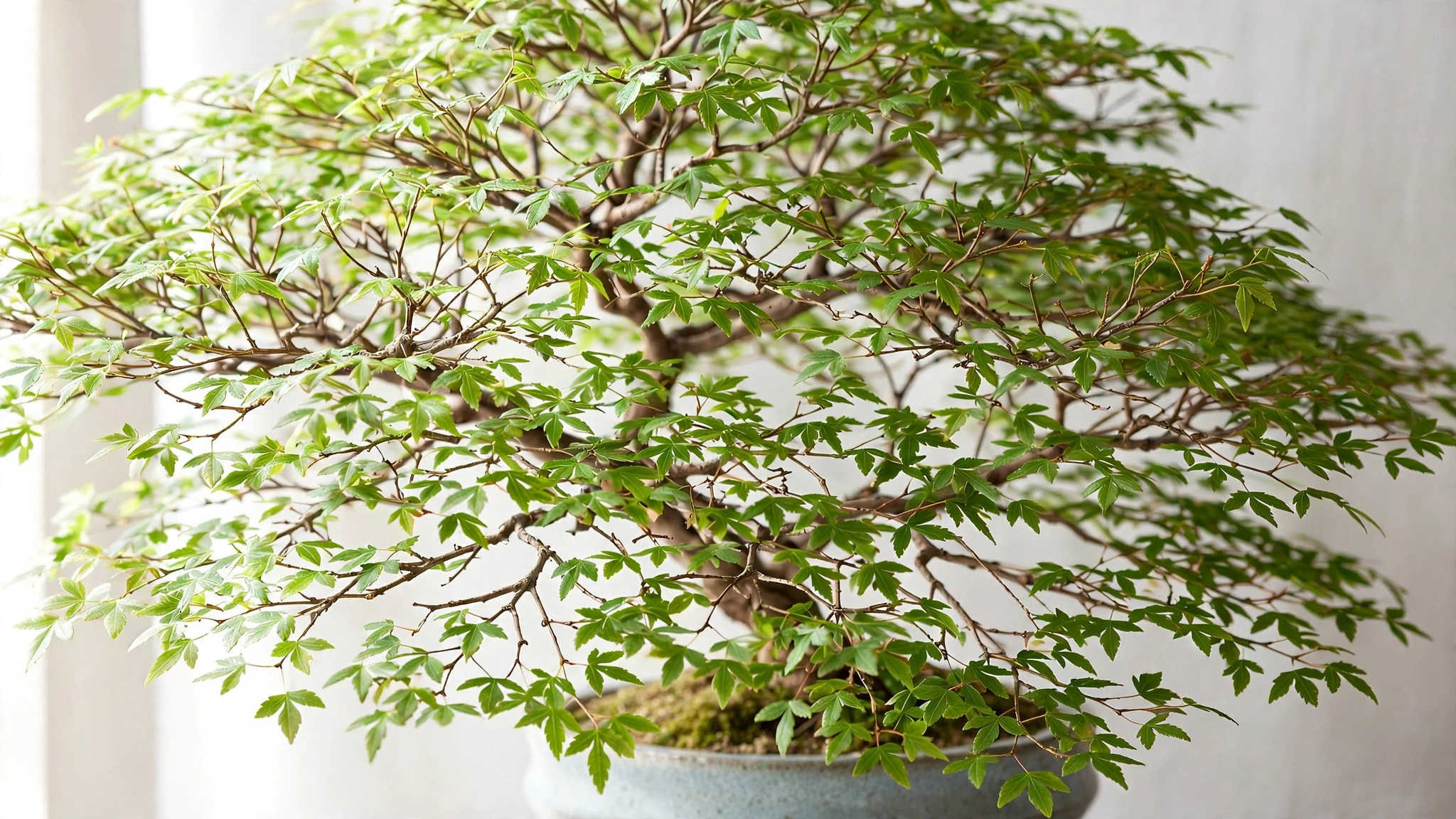
Bonsai ramification is the gradual division of branches into smaller and smaller twigs. A young tree has a few long, coarse branches; a mature bonsai has a network of fine twigs, each carrying a small cluster of leaves. That fine network makes a bonsai look like a full-sized tree seen from a distance, rather than a shrub in a pot.
Ramification is built over several seasons through repeated cycles of growth, pruning, and regrowth: each cut back usually produces two or more new shoots below the cut. This guide covers bonsai branch ramification step by step.
What Is Bonsai Ramification?
Ramification describes a bonsai’s branching structure. In a well-ramified tree, branches divide repeatedly away from the trunk, each division thinner than the one before it, with the finest twigs at the canopy edge. This taper from thick to fine is a clear sign of a developed bonsai.
A fine branching bonsai creates the illusion of age and scale. Without ramification, a bonsai looks unfinished, with long bare branches and leaves only at the tips. Dividing branches also tends to produce smaller leaves, but leaf reduction should never be forced by starving or damaging the tree.
Primary, Secondary, and Tertiary Branching
Bonsai growers describe branches by their order, counting outward from the trunk.
Primary branches
Primary branches grow directly from the trunk and form the main structure of the tree. A bonsai usually has only a few, and their placement matters more than their number. Space them around the trunk, with no two at the same height on opposite sides; the lowest is usually thickest and longest. Develop them first, and correct a badly placed branch early rather than building fine twigs on one that will later need removal.
Secondary branches
Secondary branches grow from the primary branches. They are thinner and shorter, and they fill out the silhouette. A primary branch may carry several, spaced so they do not shade each other out. In many styles, they form distinct foliage pads with small gaps, so light can reach the inner branches.
Tertiary branches and fine twigs
Tertiary branches grow from secondary branches and divide again into fine twigs — this is where true ramification becomes visible. The short, numerous twigs each end in a small cluster of leaves or buds, so a well-ramified canopy looks full even before the leaves open in spring. This is the heart of bonsai twig development.
How Pruning Builds Ramification
Pruning is the main tool for creating ramification. Removing a shoot tip releases the buds below it, and in many species two or more then grow into new shoots, though the exact response varies by species and tree health.
A light cut encourages branching while leaving enough leaves for quick recovery. A heavy cut costs more energy and may leave a bare section that takes a long time to fill in.
Clip and grow
In bonsai clip and grow, a basic method for many deciduous species, a shoot grows freely, then is cut back to one or two pairs of leaves or buds; the new shoots grow and are cut back again, each cycle adding a division. Early on, longer growth helps a branch thicken; during refinement, shorter growth keeps twigs fine and internodes — the spaces between leaves — short.
Pinching: A Lighter Touch Than Pruning
Pinching is a gentler form of shoot management: the grower removes the soft, growing tip of a new shoot, often with fingers or fine scissors. It stops the shoot extending and encourages side buds, but removes very little leaf area.
Pinching is most useful during refinement, when the branch structure is already in place and the goal is to keep new growth short and dense. It also helps maintain the shape of foliage pads.
Pinching is not a substitute for pruning: it cannot correct a branch that is too long or wrongly placed, or create branches on bare wood. Doing it too often or too early can weaken the tree. Let a shoot extend to a few leaves before pinching.
Shoot Selection: Choosing What Stays and What Goes
Every time a branch is cut back, it may produce more shoots than are needed. Keeping all of them leads to a crowded branch with crossing shoots and weak growth inside. Removing too many leaves the branch sparse and slows further division.
A useful starting point is to keep two shoots where one shoot was cut, and to remove the rest. The kept shoots should grow in different, useful directions. Shoots that grow toward the viewer, straight down, back into the tree, or across another branch are usually removed first, while the new shoots are still young and soft.
Light, Vigor, and Branch Health
Ramification depends on light reaching the inner and lower branches. If the outer canopy becomes too dense, the inner twigs are shaded out, lose their leaves, and die back, leaving a tree that looks full outside but is bare inside.
Regular thinning helps prevent this: removing a few shoots or leaves from the outer canopy lets light reach the interior, keeping inner buds alive. Good light management is central to bonsai canopy development.
Vigor — the strength and speed of growth — also affects ramification. A vigorous tree produces strong shoots that divide readily. A weak tree produces short, sparse growth and may not respond well to pruning. Before working on ramification, make sure the tree is healthy, with suitable soil, adequate water, appropriate light, and no serious pest or root problem. If a tree is weak, recovery comes first, not refinement.
Development Versus Maintenance
Ramification work changes as a tree matures. In the development stage, the goal is to build structure and thickness. Branches grow longer, and cuts encourage division and set the direction of new growth.
In the maintenance stage, the structure is largely set, and the goal is to keep the twigs fine and the canopy in shape. Growth is kept shorter, pinching is used more often, and the tree is pruned more lightly but more frequently.
Many trees move back and forth between these stages: a coarse branch may need a period of development again. Recognizing which stage a branch is in helps the grower choose the right technique.
Conifers and Deciduous Trees: Different Approaches
The techniques for ramification differ between deciduous trees and conifers, and using the wrong approach can damage a tree.
Deciduous trees
Deciduous trees, such as maples and elms, respond well to pruning and clip and grow. They produce new shoots readily from buds along a branch, and many back-bud on older wood, so a long branch can be shortened and new growth expected further back. Pinching during the growing season keeps internodes short. Most structural pruning is done while the tree is dormant or just before growth begins; exact timing depends on species and climate.
Conifers
Conifers, such as pines and junipers, do not back-bud readily on old, bare wood, and a branch cut back to a point with no live foliage may not regrow. Ramification is therefore built gradually, by managing each year’s new growth and keeping live foliage close to the branch. For pines, the spring candles — the soft, upright new shoots — are pinched or cut to different lengths to strengthen weak areas or weaken strong ones. For junipers, the growing tips are pinched or trimmed to encourage the foliage to divide into smaller pads. Wiring is often used to position branches and open the canopy, but it must be removed before it cuts into the bark.
A Practical Step-by-Step Approach
- Assess the tree. Identify coarse, bare, or overcrowded areas and check that the tree is healthy first.
- Work from the structure outward. Correct major problems before starting fine pinching.
- Cut back to a useful bud. Cut just above a bud pointing where new growth is wanted.
- Let the new shoots grow. Allow them to develop leaves and gain strength before cutting again.
- Select the shoots to keep. Remove shoots that cross, grow inward, or duplicate another; keep those that fill gaps.
- Repeat the cycle. Cut the kept shoots back again to encourage another division.
- Thin for light. Remove a few outer shoots if the interior is becoming shaded.
- Review and rest. If the tree looks tired, give it a season with less pruning.
Repeat this cycle over several years. A tree worked on steadily, a little at a time, develops better ramification than one cut hard once and then left alone.
Common Mistakes
- Pruning too hard, too often. Removing a lot of foliage at once can weaken the tree.
- Pinching every shoot as soon as it appears. This can produce thin, weak growth and prevent the tree from building the energy it needs.
- Keeping every new shoot. Crowded branches shade each other out and the interior dies back.
- Letting the top dominate. If the strongest shoots at the top are left unchecked, the lower branches weaken and may die.
- Cutting conifers like deciduous trees. Cutting a conifer branch back to bare wood can kill it. Keep live foliage on conifer branches.
- Ignoring the health of the tree. Ramification work on a weak or stressed tree can set it back. Restore health first.
- Expecting results in one season. Fine ramification takes years; judging the work after one pruning session leads to overcorrecting.
Frequently Asked Questions
How long does it take to develop good bonsai ramification?
Usually several growing seasons, depending on species, age, vigor, and how much structure is already in place. A tree with good secondary branching can improve noticeably in two or three seasons.
Can I create ramification on a young bonsai?
Yes, but the priorities differ. On a young tree, build the trunk and primary branches first; the fine twig stage comes later. Creating fine ramification too early usually produces a small, dense canopy on a weak foundation.
Why are the inner branches on my bonsai dying?
Usually shading: a dense outer canopy blocks light from the inner twigs, which weaken and die back. Thinning the outer canopy, balancing vigor, and keeping the tree healthy are the usual first steps.
Should I defoliate my bonsai to improve ramification?
Defoliation is used only in limited contexts, with certain vigorous deciduous species, and only on healthy trees. It is not routine, and it can weaken or kill a tree if done at the wrong time. Pruning, pinching, and shoot selection are safer.
Is wiring needed for ramification?
No, but it is often used alongside pruning to position branches and open the canopy to light. Check wire regularly and remove it before it cuts into the bark. For many deciduous trees, clip and grow alone can build good ramification.
Conclusion
Fine branch ramification turns a bonsai from a pruned shrub into a convincing miniature tree, built slowly through repeated cycles of growth, pruning, shoot selection, and thinning, with attention to light, vigor, and species. Work a little at a time and look at the whole tree before each cut. For a next step, follow one branch on a healthy tree through a single cycle of growth, cutting back, and shoot selection, and observe how it responds.