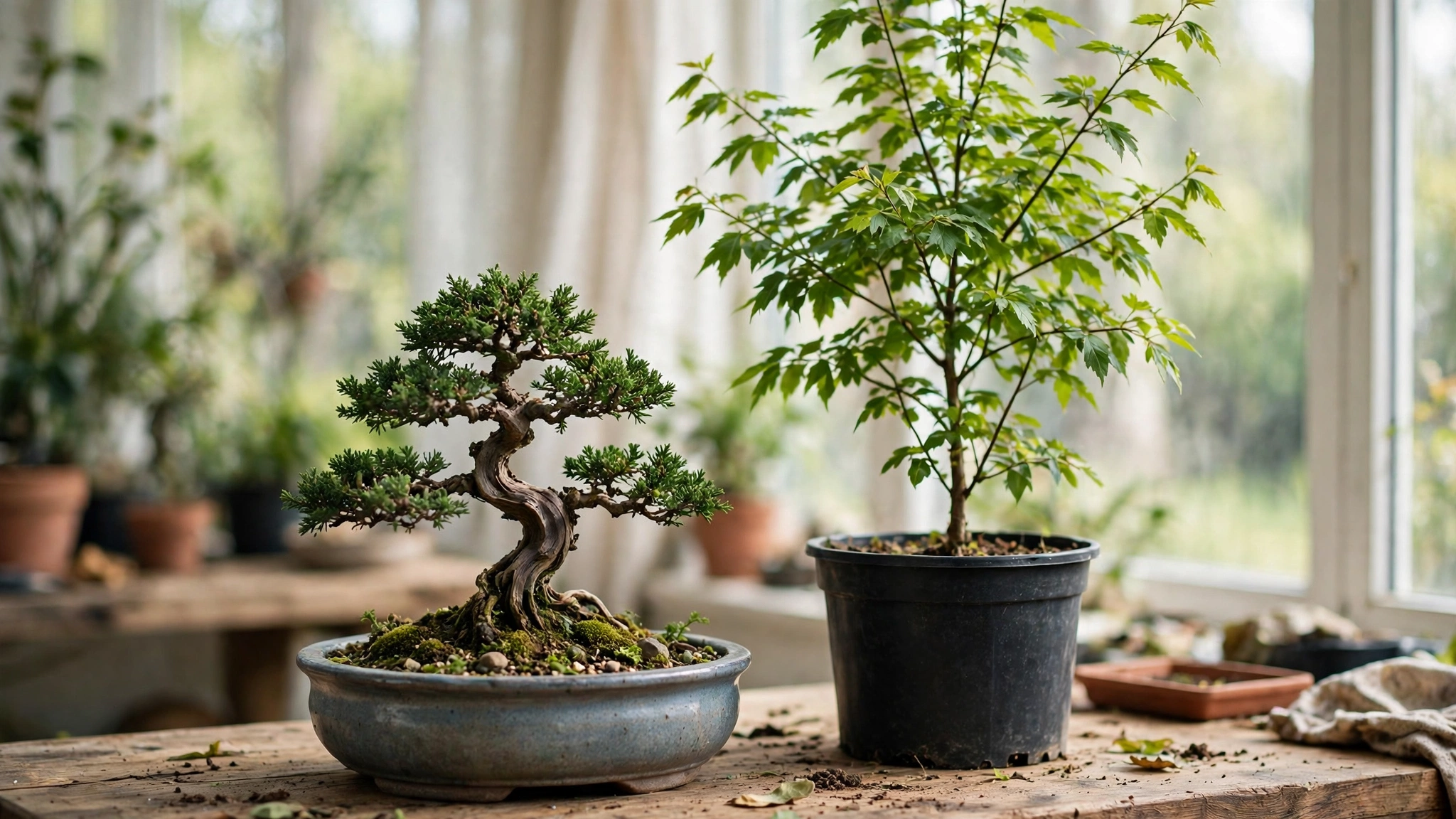
If you are wondering how to make a bonsai tree smaller, the honest answer is that no single trick does it. Bonsai size is controlled by several techniques working together over time: a small container, careful pruning, thoughtful branch development, and a design that keeps every part of the tree in proportion. No spray, special soil, or single cut will shrink a healthy tree overnight.
You can still reduce a bonsai, keep it at a smaller size, or start a new tree with a small final size in mind, provided the work is planned and respects the tree’s health and species.
Can You Actually Make a Bonsai Tree Smaller?
Yes, within limits. You can reduce a bonsai’s height and spread by shortening branches, removing an overly tall top, encouraging new growth closer to the trunk, and keeping the tree in a container that limits root growth. What you cannot do is turn a naturally large, vigorous tree into a tiny, healthy tree in one session. The tree still needs enough foliage to make food through photosynthesis, enough roots to take up water and nutrients, and time to recover from each round of work.
Think of it as a balance between the size you want and the tree’s need for leaves, roots, and energy. Push too far and the tree loses vigor, drops branches, or becomes vulnerable to pests, disease, and weather stress.
How Bonsai Size Is Really Controlled
Bonsai size control rests on four connected factors, and changing one usually affects the others.
Container culture
The pot is the most basic size control in bonsai. A small, shallow container limits soil and therefore root growth, so the tree takes up less water and fewer nutrients and grows more slowly. But a pot too small for the tree’s current roots and foliage will cause chronic stress.
Pruning
Pruning is the main tool for shaping and reducing a bonsai. Maintenance pruning removes new shoots beyond the intended outline; structural pruning shortens larger branches to change height or spread. When you shorten a long shoot, buds below the cut often grow, creating branching closer to the trunk. But pruning removes leaves, the tree’s energy source, so work gradually and let the tree regain vigor between major sessions.
Branch development
Branch development, sometimes called ramification, is how a bonsai builds fine, divided branches. A tree with well-developed ramification has many small twigs instead of a few long, coarse branches, so it takes up less space and looks like a mature tree in miniature. You build it by selecting shoots, pruning them back to a bud or side branch, and letting the tree branch again — slow work that develops over years, not weeks.
Proportion
Proportion is what makes a small bonsai look believable rather than simply stunted: a trunk thick enough for its height, branches spaced and tapered naturally, and leaves small enough not to overwhelm the design. A species with naturally small leaves will look in proportion at a small size, while a species with large leaves may never look quite right as a very small tree.
Leaf Size: What Can and Cannot Change
Leaf size varies with species, light, water, nutrition, and the age and position of the shoot. Leaves grown in strong light with moderate water and feeding are often smaller than shaded, heavily fed leaves. Leaves on fine, well-ramified branches are often smaller than leaves on vigorous shoots. So technique can influence leaf size.
What technique cannot do is change a species’ basic leaf size. A species with leaves naturally several inches long will not reliably produce leaves a fraction of an inch long, no matter how it is pruned. There is a floor set by the plant’s genetics. If you choose a species with large leaves and try to keep it as a very small bonsai, you will fight that floor for the life of the tree.
Very small, pale, or sparse leaves can also signal stress, poor nutrition, or root problems rather than success. If leaves become smaller and weaker at the same time, the tree probably needs more recovery time or a larger pot, rather than more reduction.
Which Species Suit Small Bonsai?
Species suitability is a major factor in successful bonsai size control. Some species naturally have small leaves, fine twigs, and a willingness to branch. Others have large leaves, coarse growth, or long internodes — the spaces between leaves along a shoot — which makes them harder to keep small and convincing.
Species often used for small bonsai include many junipers, pines with short needles, Chinese elm, Japanese maple, and small-leaved ficus types. These are general examples, not a guarantee: varieties, climate, and growing conditions all matter. Species with large leaves, such as some oaks and chestnuts, are usually better as larger bonsai.
How to Reduce the Size of an Existing Bonsai
If you already have a bonsai larger than you want, use bonsai pruning for size and reduce it in stages rather than all at once. This gives the tree time to respond and lets you see how it reacts before you do more.
- Assess the tree and set a realistic target. Check its health first: a weak, stressed, or recently repotted tree should recover before any major reduction.
- Plan the new outline. Look for a side branch or bud below each point you want to shorten, because the tree needs a growing point to continue from.
- Do structural pruning first, in the right season. Shorten the branches that define height and spread, using clean, sharp tools. Timing varies by species, so check species-specific guidance before you cut.
- Let the tree recover. Give it suitable light, water, and feeding. New shoots will show you where the tree is willing to branch.
- Build finer branching closer in. Select shoots that fit the new outline and prune them back to encourage further branching. Repeat over several growing seasons.
- Adjust the pot only when the tree allows it. Once the canopy is smaller and the tree is vigorous, you may move it to a smaller pot at repotting time. Do not reduce the pot and the canopy drastically at the same time.
- Maintain the new size. Prune new shoots as they extend beyond the outline. Small, frequent maintenance is safer than infrequent, heavy cuts.
Keeping a Small Bonsai Small
Reducing a tree is only half the work. Keeping it small needs ongoing attention, because a healthy tree will keep trying to grow. In the growing season, prune new shoots back to one or two leaves or buds, depending on the species, to keep the canopy compact and encourage branching. Conifers and deciduous trees respond differently, so learn the method for your species.
Feeding and watering also affect vigor. Heavy feeding and abundant water produce faster growth, larger leaves, and longer shoots, but underfeeding or underwatering a small bonsai to keep it small will quickly cause stress. Aim for balanced care: enough water and feeding to keep the tree healthy, without excess that drives coarse growth.
Root Constraints and Their Limits
Roots set real limits on bonsai size. A bonsai’s roots live in a small volume of soil, which limits how much water and nutrition the tree can take up. That is part of how a small pot restrains growth, and why root health matters: in a small pot, there is little margin for root rot, drying out, or a root system too dense.
Root pruning during repotting can keep a tree in a small pot, but it should be done conservatively. Removing too many roots at once leaves the tree unable to support its foliage. Remove a modest portion of the outer roots, shorten circling roots, and leave enough fine roots to take up water.
Common Mistakes When Trying to Make a Bonsai Smaller
- Cutting back too much at once. Removing a large share of the foliage in one session leaves too little energy to recover.
- Starving the tree to keep it small. Withholding water or fertilizer creates a stressed tree with weak growth, not a healthy miniature.
- Using a pot that is too small too soon. Reduce the top first, then the pot, and only when the tree is vigorous.
- Choosing the wrong species for a very small size. A species with large leaves and coarse growth will always look out of proportion as a tiny bonsai.
- Pruning at the wrong time. Timing varies by species, so check before you cut.
- Leaving wire on too long. Wire left in place will cut into growing bark and leave scars. Remove it before it bites in.
Frequently Asked Questions
Can I make a bonsai tree smaller by pruning it?
Yes. Shorten long branches to a suitable side branch or bud, and maintain the new outline with regular shoot pruning. Work in stages and let the tree recover between major sessions. Pruning alone will not change the species’ natural leaf size, and it works best with a suitable pot and good branch development.
How do I reduce bonsai leaf size?
Strong light, moderate watering and feeding, and fine branch development tend to produce smaller leaves in many species. But there is a limit set by the species itself. Avoid forcing smaller leaves by starving the tree or defoliating it without species-specific guidance. If small leaves are a priority, start with a species that naturally has small leaves.
Will keeping a bonsai in a small pot keep it small?
A small pot restrains growth by limiting root space, water, and nutrients, but on its own it will not create a well-shaped small bonsai. Without pruning and branch development, a tree in a small pot may simply become weak or unbalanced. The pot should match the canopy: small enough to restrain growth, but large enough to support the foliage the tree needs.
Can I make a bonsai smaller without harming it?
Yes, if you work gradually. Reduce the canopy in stages, prune in the right season for the species, leave enough foliage for recovery, and avoid reducing the roots and the top drastically at the same time. Watch for weak growth or dieback and pause if they appear. A tree that is already weak, sick, or recently repotted should recover before any major reduction.
Does bonsai miniaturization work for every species?
No. Species differ in leaf size, internode length, branching habit, and vigor, and those differences set real limits on how small a bonsai can convincingly be. Species with small leaves and fine branching suit small bonsai best, while species with large leaves or coarse growth are usually better as larger bonsai.
Conclusion
Learning how to make a bonsai tree smaller is really about learning how bonsai size works. A small bonsai is not a normal tree that has been starved or cut back once. It is a tree whose container, pruning, branch development, and proportion have been managed together, patiently, over several seasons.
If your tree is larger than you hoped, check its health, plan the new outline, and make the first reduction in the right season for the species. Then give it time to respond. Next, study small bonsai techniques for pruning and ramification.