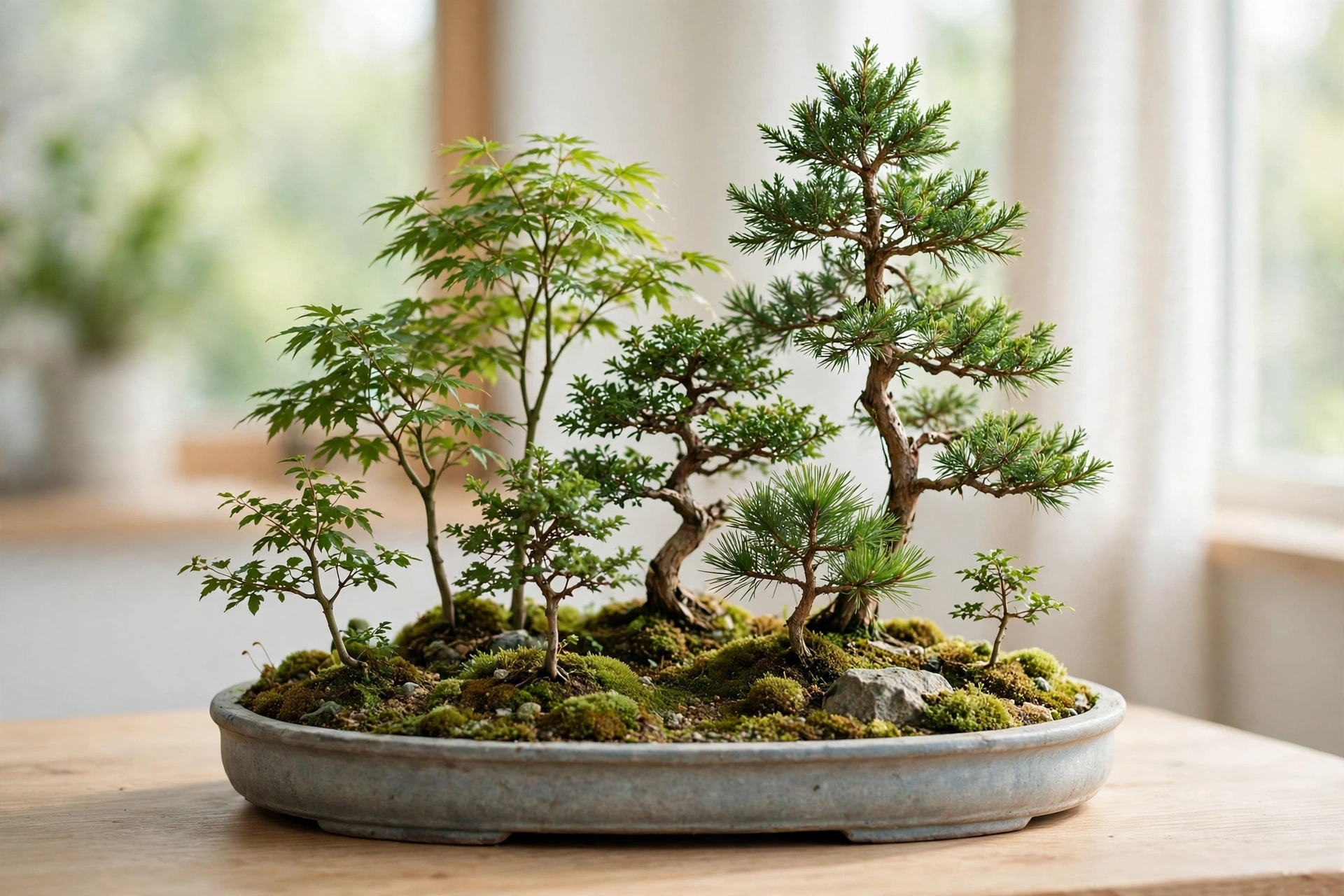
A bonsai forest planting is a group of several trees grown together in one container to suggest a small woodland. Instead of one trunk carrying the whole design, the composition relies on the relationship between the trees: a tall dominant tree, supporting trees of different heights, and smaller trees at the edges that suggest distance. Unlike styling a single tree, you also arrange a landscape and balance the needs of several trees in one shallow pot.
What Is a Bonsai Forest Planting?
A bonsai forest planting, also called a group planting, is a traditional bonsai form in which three or more trees share a single container. In Japanese, this style is known as yose-ue, a planting of many trees together. The trees are usually the same species, arranged to suggest a natural forest rather than a row of identical specimens.
Three trees can form a simple group, but five, seven, or nine trees usually look more natural, because odd numbers avoid perfect symmetry. For a first forest, five to seven trees is a practical range. The trees should not stand in a straight line at even spacing: the dominant tree sits slightly off center, other trees group around it, and the smallest trees sit near the edges.
Choosing Compatible Trees for a Bonsai Forest
Use One Species
Use a single species for every tree. One species gives a unified look, with matching bark, leaf size, and growth habit. Mixed-species plantings are possible, but harder to manage, because species grow at different rates and may need different watering or light. Common choices include Japanese maple, Chinese elm, Japanese black pine, juniper, beech, and zelkova, depending on climate. Temperate species need seasonal change and winter dormancy, while tropical species need warmth and protection from cold.
Match Vigor and Growth Rate
The trees should have similar vigor, meaning similar strength and growth rate. If one tree is much more vigorous, it will grow faster, shade its neighbors, and take a larger share of water and nutrients, and weaker trees may die back. Look for material of similar age and health, with trunks that differ in thickness and height but not in condition. Nursery stock, young pre-bonsai material, and seedlings can all work if the trees are healthy.
Consider Leaf Size and Scale
Species with naturally small leaves usually work best, since very large leaves can make small trees look out of scale. Decide the final size first: a forest six to ten inches tall can sit on a bench, while trees two feet tall need a much bigger container.
Planning the Layout
Selecting the Dominant Tree
Every forest needs a dominant tree, usually the tallest tree with the thickest trunk. It is the visual anchor, and it often sits slightly off center, toward the back or to one side. Choose it first, then place the supporting trees around it. The second-tallest tree often sits near it but not directly beside it, so the two tallest trunks do not compete, and the rest step down in height toward the edges.
Arranging Heights and Spacing
Think of the forest in three layers: foreground, middle ground, and background. Taller trees usually sit toward the back or middle, shorter trees toward the front, but not as a simple staircase; some variation within each layer keeps it from looking like a row of steps. Spacing matters as much as height. Trees too close together compete for light and air, while trees too far apart look like separate bonsai sharing a pot. Leave enough space for air and light, while keeping the group close enough that the canopies almost touch.
Creating Visual Depth
Visual depth makes a forest feel like a real woodland rather than a flat row. Smaller trees placed slightly forward or to the sides appear farther away, because the eye reads smaller size as greater distance. A small open space between some trees can suggest a path, and a low mound of soil can lift the back of the planting. A small rock, used sparingly, can suggest a boulder, and moss can suggest a forest floor, but neither should cover the base of the trunks.
Soil, Container, and Root Preparation
Choosing the Soil
Use a free-draining bonsai soil mix that holds some moisture without staying soggy, based on granular inorganic components such as akadama, pumice, and lava rock, with a small amount of organic material if appropriate for the species. Avoid dense garden soil or heavy potting soil: these hold too much water in a shallow container and reduce air around the roots.
Choosing the Container
Forest plantings usually grow in shallow, wide containers, often oval or rectangular, with drainage holes. The container should hold all the trees with room for roots and future growth, but not be so large that the trees look lost; a useful starting point is a container about two-thirds as long as the height of the tallest tree.
Preparing the Roots
Before planting, inspect each tree’s roots. Remove dead or badly damaged roots, and shorten overly long roots so the trees fit without circling or bending sharply. Keep root pruning moderate, especially if you are also pruning branches. If trees come from nursery pots, gently remove most of the old soil so the new bonsai soil contacts the roots.
How to Plant a Bonsai Forest: Step by Step
Plant in early spring for temperate species, or at a time suited to the species for tropical trees. Avoid extreme heat or hard frost.
- Prepare the container. Cover drainage holes with mesh, add a thin layer of coarse soil, and have soil mix, a chopstick, water, and tools ready.
- Arrange the trees dry. Place them on the empty container, check heights and spacing, and adjust until it looks natural.
- Position the dominant tree first. Set the tallest tree in place and hold it upright while adding soil around its roots.
- Add supporting trees one at a time. Work from tallest to smallest, adding soil around each root ball.
- Work soil into the roots. Use a chopstick to gently push soil between the roots, removing air pockets.
- Secure trees if needed. If a tree is unstable, pass a wire through the drainage holes until roots establish, then remove it.
- Shape the soil surface. Build gentle mounds and low areas to suggest terrain, keeping soil slightly below the rim.
- Water thoroughly. Water until it flows freely from the drainage holes. Water again after a few minutes if the soil settles.
- Add moss and accents last. Press moss gently into the soil and place any small rock naturally, without covering a trunk base.
After planting, keep the forest sheltered from strong wind and harsh sun for a few days, then move it to its normal position.
Long-Term Maintenance
Watering a Group Planting
Watering a forest is more demanding than watering a single tree, because several trees draw from the same soil. Check moisture by feeling the surface and, if possible, below it with a finger or chopstick. Water thoroughly when the soil begins to dry, until water runs from the drainage holes, and avoid light sprinkling that only wets the surface. Edge trees may dry faster than those in the center, so check the whole surface and water evenly.
Pruning and Shaping the Group
Prune each tree to keep its shape and the group balanced. Remove inward-growing shoots that crowd neighbors, and shorten shoots that break the forest silhouette. Keep neighboring canopies from merging into one mass, so each tree stays recognizable. Pruning also manages light: if one tree shades its neighbors, prune it back, and if a tree is weak, avoid heavy pruning until it recovers. Maintenance pruning is often done in the growing season; structural pruning is usually done when the tree is dormant.
Feeding, Repotting, and Renewal
Feed during the growing season according to the species and the product label, and avoid heavy feeding right after repotting or when a tree is stressed. Repotting a forest means lifting the whole group, inspecting the roots, and returning the trees to a similar arrangement, usually every two to five years. Some trees may weaken or die over time, especially if shaded; remove a dead tree carefully and decide whether to replace it or redesign the group.
Common Mistakes in Bonsai Forest Planting
- Mixing species with different needs. Trees needing different water, light, or winter cold will not thrive together.
- Planting in a straight line. A straight row looks artificial and wastes depth. Use irregular spacing and varied heights.
- Using trees of very different vigor. A fast-growing tree will dominate and shade or starve its neighbors.
- Crowding trees too closely. Close trees compete for light and air, and branches tangle.
- Choosing a container too small or shallow. A small pot leaves no root room and dries quickly.
- Neglecting the smaller trees. Small trees add depth and distance, so check them for light, water, and pests.
Frequently Asked Questions
How many trees should a bonsai forest planting have?
Three or more trees, with odd numbers such as five, seven, or nine looking most natural. For a first forest, five to seven trees is a good range. Very large groups are harder to water, prune, and repot evenly.
Can I mix different species in a bonsai forest?
It is possible, but not recommended for a first forest. Different species grow at different rates and may need different watering, light, and winter care, so the weaker species may decline. One species keeps care consistent and the look unified.
What is the best species for a bonsai forest planting?
There is no single best species for every grower. It depends on climate, experience, and whether trees live outdoors. Japanese maple, Chinese elm, Japanese black pine, juniper, beech, and zelkova are all used in suitable climates.
How often should I water a bonsai forest planting?
There is no fixed schedule for every forest. Check the soil regularly and water thoroughly when it begins to dry, until water flows from the drainage holes. Shallow pots dry faster, and hot weather increases water use.
How do I keep the trees from growing unevenly?
Prune vigorous trees more and weaker trees less, so light reaches the smaller trees. Remove shoots that shade neighbors and do not let one canopy dominate. If one tree is far more vigorous than the rest, replacing it may be better than fighting its growth every year.
When should I repot a bonsai forest planting?
Most forests need repotting every two to five years, depending on species, age, and how fast roots fill the container. Signs include water running off the surface and trees drying very quickly after watering.
Conclusion
A bonsai forest planting is a group of trees grown together to suggest a woodland. Its success depends on choosing compatible trees, planning the layout, and maintaining the group over time. Use one species with similar vigor, choose a dominant tree and arrange the others at varied heights and distances, and choose soil and a container that give all the trees room to grow. To start, gather five to seven healthy trees and practice the arrangement in the empty container before planting.