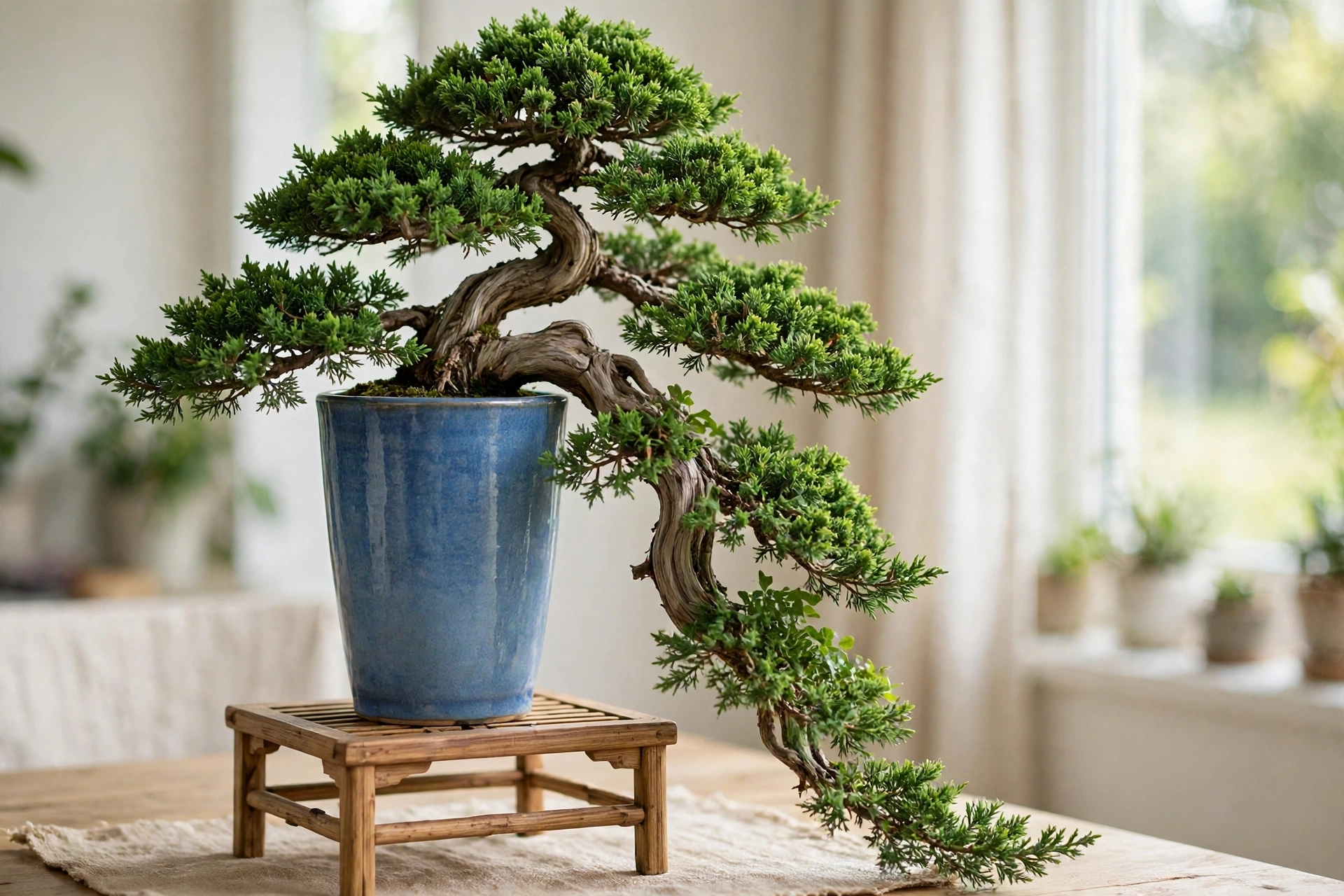
A cascade bonsai style is one of the most dramatic forms in bonsai. Instead of growing upward, the trunk flows downward, falling well below the base of the pot, like a tree clinging to a cliff face.
When it is done well, the result looks natural and balanced; when forced, it can look strained or unhealthy. Creating this style is therefore as much about choosing the right tree as it is about wiring and pruning.
What Is the Cascade Bonsai Style?
The cascade bonsai style, known in Japanese as kengai, describes a bonsai whose trunk grows downward past the bottom of its container. The lowest foliage is normally well below the base of the pot, and the trunk drops in a graceful curve rather than a straight line, like a tree growing from a steep slope or rocky ledge.
A true cascade is not simply a leaning tree. The trunk should have movement, with changes of direction, and the branches should be arranged so the composition looks stable and intentional. Foliage is usually held in pads along the trunk, and the apex is often small and set back, so the eye is drawn downward.
Cascade vs Semi-Cascade: How to Tell Them Apart
Cascade and semi-cascade are closely related, but they are not the same form. The difference is mainly how far the trunk descends in relation to the pot. In a full cascade, or kengai, the trunk falls below the base of the pot, and the tip often reaches well below that level — sometimes as far as one and a half times the height of the pot below its base.
In a semi-cascade, or han-kengai, the trunk extends outward and downward, but the lowest foliage stays roughly level with the base of the pot. The tree still leans strongly to one side, but the composition feels lighter. Semi-cascade is often a good choice when the material has a natural lean but not enough length for a full cascade.
Which Species and Material Suit a Cascade?
Not every species, or every individual tree, suits cascade styling. The best candidates have flexible young branches, a trunk that can be bent gradually without snapping, small or moderately sized foliage, and a growth habit that recovers well from pruning and wiring. Junipers are among the most commonly used species: many varieties are flexible, tolerate wiring, and develop the rugged, aged look that suits a cliff-side image.
Certain pines can also work for a kengai bonsai, where the grower understands the species’ growth pattern, but pines are slower to develop and less forgiving of heavy bending than junipers. Avoid species with stiff, brittle branches, very large leaves, or a strongly upright habit, and avoid very young trees with thin, straight trunks, which lack the thickness for a convincing cascade.
Choosing a Container and Display for a Cascade
The container is part of the design, not just a practical necessity. Because the trunk falls below the pot, a cascade is usually planted in a tall, deep pot that raises the tree high enough for the descending trunk to be seen clearly. A shallow pot would hide the cascade or force the foliage to rest on the bench.
The pot should be deep enough to hold a healthy root mass and anchor the tree securely, but not so large that it overwhelms the tree. Muted blues, greens, browns, and unglazed earth tones are common choices, and good drainage holes are essential, because a deep pot can hold too much moisture at the bottom. Display it on a tall stand or high bench, so the full downward line can be seen.
How to Create a Cascade Bonsai Style Step by Step
Creating a cascade is a gradual process. The timing and amount of work in each session should always be adjusted to the species, the season, and the health of the tree. Never try to do all the bending, pruning, repotting, and wiring in a single day.
1. Study the tree and choose a front
Study the tree from all sides, without cutting or wiring anything. Look for the natural movement of the trunk, the position of the main branches, and the root base. Choose the front — the viewing angle that shows the trunk line most clearly.
2. Plan the trunk line
Sketch the intended trunk line before you bend anything. Decide where the trunk will leave the pot, where it will change direction, and where the lowest foliage will sit. The trunk should curve, with a clear change of direction partway down, and the tip should often turn slightly upward at the end, suggesting the growing tip is still reaching for light.
3. Bend the trunk gradually
Bending is the heart of cascade creation, and it should be done slowly, on a healthy tree. For a young, flexible trunk, cascade bonsai wiring alone may be enough. For a thicker trunk, wrap the bending area with raffia or protective tape before wiring, to spread the pressure and reduce the risk of bark splitting. Bend a little at a time, supporting the trunk with both hands, and stop if it resists strongly: forcing a bend can crack the wood.
4. Wire the branches and build foliage pads
Once the trunk line is set, wire the main branches, working from the trunk outward. Choose branches that grow in useful directions and remove or shorten those that cross the trunk line or crowd the design. Keep wire angles even, avoid crossing wires, and remove the wire before it bites into the bark and scars it. Aim for distinct foliage pads separated by small gaps, so the trunk line remains visible, with pads becoming smaller toward the tip.
5. Secure the tree in its cascade pot
When the tree is ready for its cascade pot, position it so the trunk leaves the pot at the planned angle and the front faces the viewer. Settle the root mass firmly in the pot, working soil around the roots with a chopstick to remove air pockets. Wire the tree into the pot through the drainage holes so it cannot shift. Water thoroughly after repotting and place the tree in a sheltered position while it recovers. Repotting and heavy styling should not normally be done at the same time.
Branch Placement in a Cascade Design
Good branch placement separates a convincing bonsai cascade design from a tree that simply hangs down. The first major branch is often placed on the outside of the first bend, where it can balance the downward movement of the trunk. Later branches alternate along the trunk, with some reaching forward and some reaching back, so the design has depth. Avoid two large branches at the same height on opposite sides, and avoid branches that cross in front of the trunk. The lowest part is the focal point: it should look substantial, not like a heavy ball at the end of a thin trunk.
Ongoing Care for a Cascade Bonsai
A cascade needs the same basic care as any bonsai of its species — appropriate light, watering based on soil moisture, suitable soil, feeding, and seasonal protection — with a few extra considerations. The lowest foliage is far from the roots and can dry out faster in hot or windy weather, so check soil moisture regularly and water thoroughly. Avoid letting a deep cascade pot stay waterlogged, which can damage roots at the bottom.
The upper foliage can also shade the lower branches, so position the tree for good light and prune the upper growth when it shades the lower pads. For species that need full sun, an outdoor position is usually necessary; keeping a temperate cascade indoors year-round is likely to weaken it. Prune and wire little and often, remove vigorous upright shoots promptly, and check wire frequently. Protect the tree from wind: a tall cascade pot on a high stand is easily blown over, so use a heavy stand.
Common Mistakes in Cascade Bonsai
- Forcing a bend too far, too fast. A cracked trunk may die back. Bend gradually; some bends need more than one season.
- Choosing the wrong tree. Species with stiff, brittle branches, very large leaves, or a strongly upright habit rarely make convincing cascades.
- Using a pot that is too shallow or too small. A shallow pot hides the cascade and gives the roots too little room. Choose a tall pot proportionate to the tree.
- Hiding the trunk line. One dense mass of foliage makes the cascade look like a hanging shrub. Keep gaps between pads so the trunk can be seen.
- Neglecting the lower branches. The lowest foliage is the most vulnerable part of the tree. Give it enough light and check it regularly.
- Leaving wire on too long. Wire left in place during fast growth can cut into the bark and leave permanent scars. Check it often in spring and summer.
- Styling and repotting at the same time. Heavy bending, major pruning, and repotting in one session can overwhelm a healthy tree. Space the work across seasons.
Frequently Asked Questions
What is a cascade bonsai style?
A cascade bonsai style, or kengai, is a form in which the trunk grows downward past the base of the pot, like a tree growing from a cliff edge, with foliage in pads along the curving trunk.
What is the difference between cascade and semi-cascade bonsai?
In a full cascade, the trunk and foliage fall well below the base of the pot. In a semi cascade bonsai, or han-kengai, the lowest foliage stays roughly level with the base of the pot.
Which bonsai species are best for a cascade style?
Junipers are a common choice because their branches are flexible and they tolerate wiring well. Some pines can also work, depending on the grower’s experience and the local climate.
Can any bonsai tree be made into a cascade?
No. A tree needs a trunk that can bend without breaking, enough length to reach below the pot, and a growth habit that suits a downward design.
How long does it take to create a cascade bonsai?
It depends on the starting material and the species. A tree that already leans naturally can take a basic cascade shape in one or two styling sessions, but refining the branches and foliage pads usually takes several seasons.
How do I care for a cascade bonsai after styling?
Give it the same basic care as other bonsai of the same species — appropriate light, watering based on soil moisture, and seasonal protection — with extra attention to the lower branches, which need light and can dry out in wind. Check wire frequently.
Conclusion
The cascade bonsai style is one of the most striking forms in bonsai, but its beauty comes from restraint as much as from drama. A good cascade looks like a tree that has grown that way naturally, shaped by wind, gravity, and the edge of a cliff. That effect depends on choosing suitable material, bending the trunk gradually, placing branches with care, and giving the tree time to grow into its design. If the tree already leans and offers enough length, a cascade may be a rewarding project.