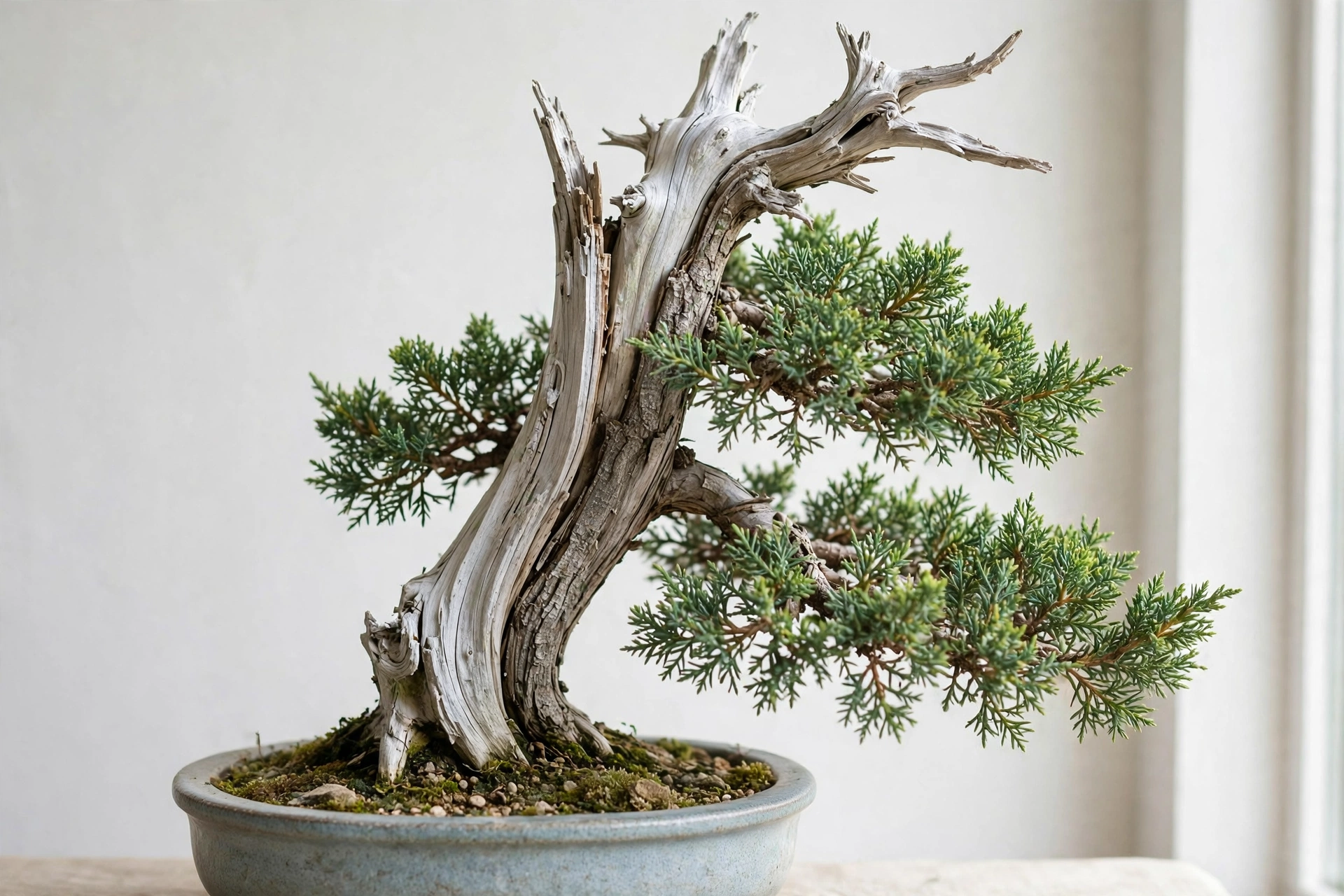
A dead branch on a bonsai is not always a flaw. Carefully created deadwood can make a tree look older and tougher, like a tree that has survived storms on a mountainside. The two most important deadwood techniques are jin and shari, and this guide explains what bonsai jin and shari are, which trees suit them, and how to create and maintain them safely, and where bonsai deadwood styling fits into a tree’s design.
Deadwood work is permanent: once bark is removed or a branch is stripped, it cannot be put back. That is why planning and caution matter as much as technique.
What Are Bonsai Jin and Shari?
Jin and shari are both forms of deadwood, but they refer to different parts of the tree. Both describe wood deliberately left bare, pale, and weathered to look as though it died naturally long ago.
Jin: A Dead Branch Tip
A jin is a dead branch stub, made by stripping the bark from a branch removed or shortened during styling and shaping the exposed wood into a tapered tip. A jin points upward or outward and reads as a branch that died and weathered away while the rest of the tree kept growing.
Shari: Deadwood on the Trunk
A shari is a strip of bonsai trunk deadwood running along the trunk. It is made by removing a narrow section of bark and exposing the wood beneath, which is then shaped and left to weather. Unlike a jin, a shari is part of the trunk itself, which makes it riskier: removing bark from the wrong place can kill a branch or even the whole tree. A well-planned shari leaves enough live bark, called the live vein, to keep the tree healthy.
Why Deadwood Matters in Bonsai Design
First, deadwood suggests age: a pale jin or weathered shari suggests decades of wind, snow, and drought.
Second, it creates contrast: pale wood stands out against dark bark and green foliage, drawing the eye to the trunk line. A shari can emphasise a trunk’s curve, while a jin can balance a heavy branch.
Third, deadwood can solve a design problem, such as a branch in the wrong place or a scar from an old cut. Add it only when it fits the character of the tree.
Which Species Suit Jin and Shari?
Deadwood features work best on species whose wood is naturally durable and whose bark and foliage suit a rugged look. Conifers are the classic choice. Junipers are the most common species for jin and shari because their wood resists rot, their foliage is compact, and their trunks develop strong movement.
Some broadleaf species, such as olive, elm, and certain maples, can carry small jin, but their softer wood rots faster. Tropical species such as ficus are generally poor candidates, because their soft wood decays quickly in warm, humid conditions.
Check the individual tree too: a weak tree, a tree just repotted, or a tree recovering from heavy pruning should not receive deadwood work. The tree needs full vigour to heal the boundary between live and dead tissue.
Planning Before You Touch a Tool
Plan every deadwood feature on the tree before removing any bark: the work is irreversible.
Study the tree from its chosen front. A jin works best at the top or where a branch already died; a shari works best along a strong curve of the trunk.
Mark the planned feature with coloured string or tape. As a rough guide, a shari should be narrower than the live bark left beside it. Plan the timing too: work when the tree is dormant or growing slowly, not in a heatwave, during repotting, or when the tree is stressed.
Tools and Safe Handling
Deadwood work uses sharp tools, so safe handling matters as much as technique. Useful tools include jin pliers, which grip and strip bark and split wood fibres; a sharp carving knife; concave cutters; and a small wire brush. Keep tools clean and sharp: blunt tools tear bark and crush wood.
Protect your hands with gloves when stripping bark, since splinters and sharp fibres are common, and wear eye protection when carving or snapping wood. Never force a tool; if a branch resists, stop and reassess rather than risking a slip that could cut into live tissue or injure your hand.
How to Create a Jin, Step by Step
Start with a jin: this jin bonsai technique is less risky than a shari. Work on a branch that is already dead, or one you have decided to remove.
- Choose the branch. Pick a branch whose position suits a jin — near the top, on the outside of a curve, or where a branch would naturally have broken.
- Cut it back. Using concave cutters, cut the branch to roughly the length you want, leaving a little extra for shaping.
- Strip the bark. Use jin pliers to grip the bark at the cut end and peel it back toward the trunk in strips. Stop where the jin should meet live wood, leaving a clean edge.
- Shape the wood. Use the pliers to split and pull the fibres at the tip, tapering it to a natural point. The tip should look broken rather than cut.
- Clean and dry. Brush the exposed wood with a wire brush to remove loose fibres. Leave the jin to dry for a few days before applying any preservative.
How to Create a Shari, Step by Step
The shari bonsai technique is more advanced and riskier than a jin. Do not attempt your first one on a valuable tree.
- Map the live veins. Before cutting, work out where the live bark must remain: a shari crossing a live vein can starve the branches above it.
- Mark the outline. Draw the shape of the shari on the trunk with a soft pencil or chalk. Keep it narrower than the live bark beside it and follow the trunk’s movement.
- Cut the bark edges. Using a sharp knife, cut along the marked outline, just deep enough to reach the wood beneath.
- Peel the bark away. Starting at one end, lift the bark strip and peel it away from the wood. Work in small sections.
- Shape the exposed wood. Use a carving knife or small gouge to shape the wood lightly, following the grain. Create a slightly hollowed surface rather than a flat one.
- Smooth the edges and dry. Neaten the boundary between live bark and deadwood so the transition looks deliberate. Allow the wood to dry for a few days before applying preservative.
Preserving and Weathering Deadwood
Fresh deadwood is warm brown or yellow; over time it weathers to pale grey or silver. You can let this happen naturally, or help it along with treatment.
The traditional preservative is lime sulphur, a solution that bleaches the wood pale and helps protect it from rot and insects. Apply it with a brush to dry deadwood, keeping it off live bark and foliage. Lime sulphur has a strong smell and should be used outdoors or in a well-ventilated space, with gloves, and following the product label and local regulations. The pale colour fades over a season or two, so reapply as needed.
If you prefer not to use lime sulphur, simply let the wood weather naturally. Whichever approach you choose, keep deadwood as dry as possible: damp wood rots quickly, so do not let water collect in hollows or grooves.
Inspect deadwood at least once a year. If the wood feels soft or crumbly, it may be rotting: remove the soft wood, let the area dry, and re-treat it.
Protecting the Live Tissue
The most important rule is to protect the living parts of the tree.
Never let preservative touch live bark, buds, or foliage. When carving near a live vein, keep tools shallow and controlled.
Do not create a shari that wraps all the way around the trunk. A complete ring of deadwood, known as girdling, cuts off the flow of water and nutrients and will kill the tree. Always leave a generous strip of live bark connecting the roots to the canopy. After deadwood work, shelter the tree for a few weeks and do no other heavy work on it at the same time.
Maintaining a Deadwood Feature
Deadwood needs light, regular maintenance to stay sound and look its best.
Once or twice a year, clean the deadwood with a soft brush and reapply preservative when the pale colour fades, usually in the dormant season.
Watch the feature as the tree grows: a jin can be shortened if the canopy outgrows it.
Common Mistakes
- Starting on a valuable tree. Practise on inexpensive material first.
- Making the feature too big. An oversized shari or jin usually looks like damage, not design.
- Ignoring the live veins. Cutting across them can starve the branches above.
- Working on a weak tree. A stressed or sick tree cannot heal deadwood edges well.
- Leaving ragged edges. Torn bark heals poorly and can widen the feature.
- Getting preservative on live tissue. It can burn bark and foliage.
- Doing too much at once. Deadwood work plus repotting and heavy pruning in one season overloads the tree.
- Forgetting maintenance. Untreated deadwood can rot within a few seasons.
Frequently Asked Questions
What is the difference between jin and shari?
A jin is a dead branch tip: a stripped, shaped branch stub that points away from the trunk. A shari is a strip of deadwood on the trunk itself, made by removing a section of bark along the trunk.
Can I create jin and shari on any bonsai?
No. Conifers such as juniper and pine are the best candidates because their wood is durable and resists rot. Some broadleaf species can carry small deadwood features, but their softer wood decays faster and needs more maintenance. Tropical species such as ficus are usually poor choices.
Is lime sulphur safe for my bonsai?
Lime sulphur is the traditional preservative for bonsai deadwood, but it must be used carefully. Apply it only to dry deadwood, keep it off live bark and foliage, and use it outdoors or in a well-ventilated space with gloves, following the product label and local regulations.
Can deadwood be removed later if I change my mind?
No. Once bark is stripped and wood is shaped, the feature cannot be undone, although a jin can be shortened. This is why planning and practising first matter so much.
How often should I maintain deadwood?
Inspect it at least once a year, usually in the dormant season. Clean off dirt and algae, trim loose fibres, and reapply preservative when the pale colour fades.
Conclusion
Jin and shari reward patience and punish haste. Plan carefully, choose a healthy tree of a suitable species, and practise on inexpensive material first. Protect the live veins, use sharp clean tools, and give the tree time to recover. With care, a well-made deadwood feature gives your bonsai a sense of age and character that pruning alone cannot create.
As a next step, read the bonsai tools guide and the trunk development guide.