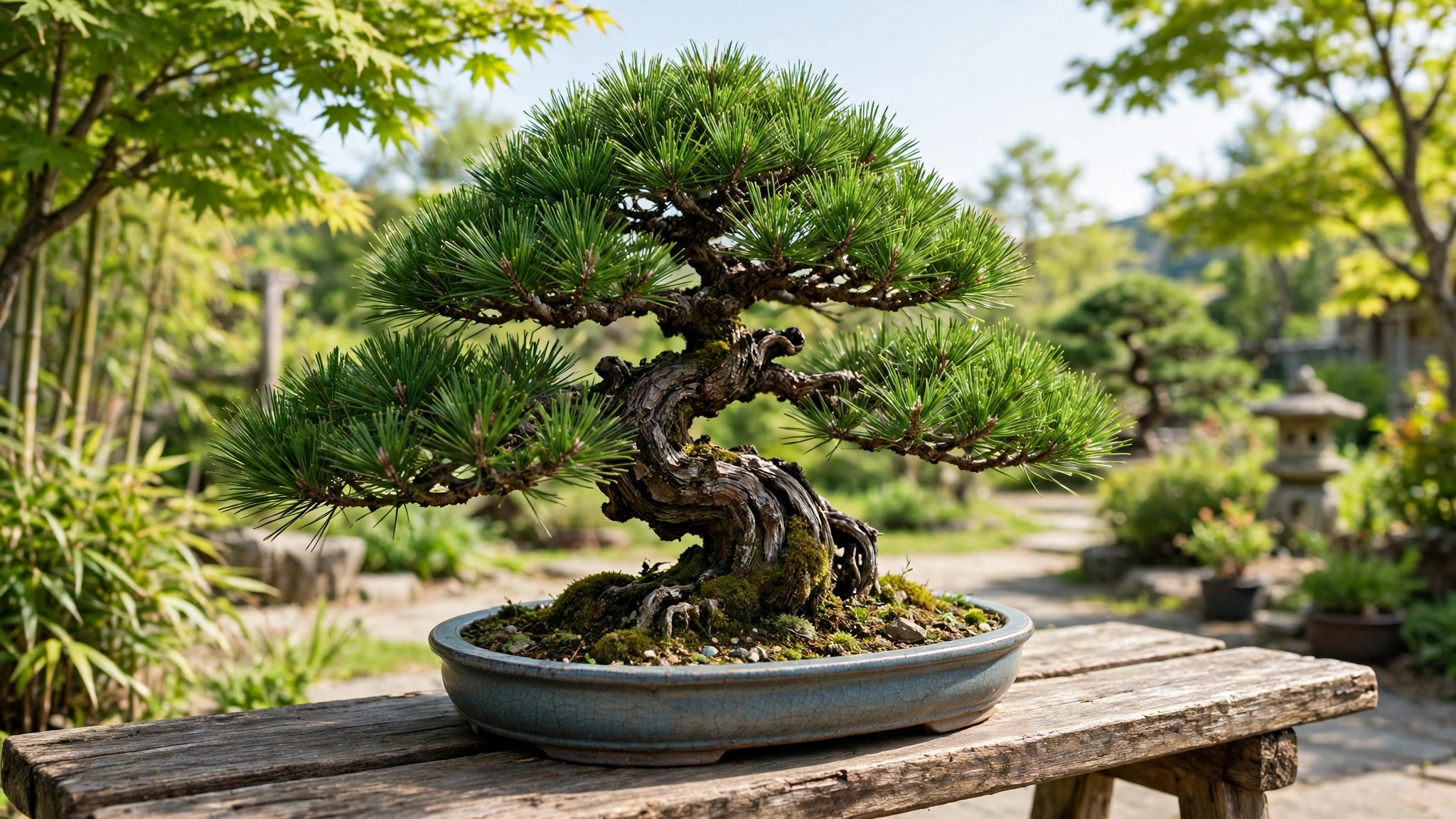
Good pine bonsai care starts with one truth: a pine bonsai tree is an outdoor tree. Pines grow in open air, full sun, and changing seasons. Give it light, water by soil, and winter rest, and it can stay vigorous for decades.
What Makes a Pine Bonsai Different
Pines are evergreen conifers: they keep their needles all year and grow in a different rhythm from leafy trees. Instead, a pine extends new shoots called candles, lengthens its needles, and then rests. That slow growth is part of what makes pines look so rugged, but it also means they recover slowly from mistakes — a pine pruned too hard or kept indoors will not bounce back the way a fast-growing tropical tree might.
Pines also need winter cold. Most pines require a period of dormancy — a cold rest — to grow normally the following spring, so pine bonsai care is fundamentally outdoor care in temperate climates.
Common Pine Species for Bonsai
Different pines behave differently, so know which one you own — timing and technique vary by species.
- Japanese black pine (Pinus thunbergii): The most widely grown Japanese black pine bonsai: dark bark, paired needles, strong growth, and it responds well to candle pruning.
- Japanese white pine (Pinus parviflora): Slower-growing, with shorter, finer needles and soft blue-green foliage; prune it gently.
- Scots pine (Pinus sylvestris): A hardy European pine with orange-brown bark on mature trunks, well suited to colder regions.
- Mugo pine (Pinus mugo): A compact, bushy pine, naturally small and tough — forgiving for beginners and hardy in cold winters.
If you are unsure which pine you have, compare needle length and bark colour with an identification guide or ask at a bonsai nursery.
Outdoor Placement and Sunlight
A pine bonsai tree needs full sun — direct sunlight for most of the day, ideally six hours or more. Good airflow matters too: still, humid air invites fungal problems, so avoid a sheltered corner with no breeze.
Do not keep a pine indoors year-round. It may survive a few days inside for display, but a permanent indoor position deprives it of light, temperature changes, and the cold rest it needs — needles thin out, growth becomes leggy, and the tree weakens. A balcony or rooftop can work, but a pine needs real outdoor conditions to thrive.
In very hot climates, a little afternoon shade can stop the soil drying out too fast.
Pine Bonsai Watering
Pine bonsai watering is about reading the soil, not following a fixed schedule. Pines prefer free-draining soil that dries out somewhat between waterings; soggy soil rots fine roots, but a root ball dried out in hot weather also suffers.
Check before watering:
- Push a finger or chopstick about a centimetre into the soil; if it feels damp, wait.
- Lift the pot. A dry pot is noticeably lighter than a wet one.
- Dry bonsai soil usually lightens in colour.
When you do water, water thoroughly: pour slowly over the whole surface until water runs freely from the drainage holes, then repeat, so the whole root ball is moist. In summer, a pine in a small pot in full sun may need water daily; in winter, when dormant, it needs far less.
Soil and Repotting
Pines need open, free-draining soil. A common mix is akadama, pumice, and lava rock in roughly equal parts. Dense garden soil or fine compost stays wet too long and can suffocate pine roots, so avoid it.
Repot in late winter or early spring, just before growth begins — young, vigorous pines every two to three years, older trees less often. Signs it is due include water running straight through without soaking in, or roots circling the drainage holes.
When repotting, remove only part of the old soil — no more than a third to a half — and trim only the longest roots. Pines rely on fine feeder roots and the fungi around them, so never bare-root a pine. After repotting, shelter the tree from strong wind and harsh sun for a few weeks until new growth shows it has recovered.
Feeding Your Pine Bonsai
Pines need modest feeding: too much fertiliser, especially nitrogen, produces long, coarse needles. A balanced, slow-release fertiliser during the growing season is usually enough; stop in late autumn so the tree can harden off for winter.
The right amount depends on the tree’s age, the soil, and how much growth you want: a young pine you are thickening needs more food than a refined, mature tree. Very long needles usually mean you are feeding too heavily; weak, pale growth may need a little more. Never fertilise a weak, sick, or recently repotted tree — feeding does not fix stress.
Pine Bonsai Pruning: Candles and Shoots
Pine bonsai pruning centres on the candles — the soft, pale new shoots that appear in spring. Shorten strong candles more and weak candles less to balance the tree’s energy and shape its density and needle length.
For a two-flush pine such as Japanese black pine, remove or shorten the spring candles in late spring or early summer to encourage a second flush of shorter shoots. Single-flush pines such as Japanese white pine, Scots pine, and mugo pine are pinched or shortened once and left to grow. Applying black pine techniques to a white pine can weaken it badly, so confirm your pine’s type before cutting.
A few practical rules help:
- Work only on a healthy, vigorous tree — never candle-prune a weak or recently repotted pine.
- Use sharp, clean tools; ragged cuts invite disease.
- Shorten the strongest candles first, then the medium ones; leave the weakest alone.
- On a young or uncertain tree, work in stages and watch how it responds.
Beyond candles, remove dead or crossing branches. Structural pruning is best done in late autumn or winter, when the tree is dormant and you can see the branch structure clearly.
Pine Bonsai Needle Care
Pine bonsai needle care keeps foliage dense and healthy. Each autumn, remove old needles that are yellowing or brown and thin crowded areas so light and air reach the inner branches. This is needle plucking: pull old needles downward and outward in the direction they grow, without tearing the bark.
Thinning also balances growth: letting light in encourages back-budding — new shoots forming closer to the trunk — which keeps the tree compact.
Do not strip a pine bare — leave enough healthy needles for the tree to photosynthesise. Needle work is best done in autumn, after the growing season.
Wiring a Pine Bonsai
Wiring sets branch positions and refines the shape of a pine. Wire in late autumn or winter, when growth has slowed and branches are easier to see. Use aluminium or copper wire about one-third the thickness of the branch, wrapped at a steady angle of roughly 45 degrees.
Check wired branches regularly during the growing season: wire can bite into bark as branches thicken, leaving scars that take years to heal. Remove wire as soon as it presses into the bark, cutting it off in short pieces rather than unwinding it. Never wire a weak tree, and avoid wiring and heavy pruning in the same season.
Winter Dormancy and Protection
Winter dormancy is not optional for pines. In temperate climates, most can stay outside all winter with simple protection; the main risk is roots freezing in a small pot, which has far less insulation than the ground.
Protect the roots by placing the pot on the ground, mulching around it, or moving it into an unheated shed, garage, or cold frame during the coldest spells. Water sparingly through winter, only when the soil is drying out and temperatures are above freezing. Never bring a pine into a heated room for winter — the warmth breaks dormancy.
Scots pine and mugo pine handle deep cold well, while Japanese black pine is less hardy and needs more shelter.
Pests and Diseases
Healthy pines in good airflow rarely have serious problems. Watch for aphids on soft new growth in spring, pine scale as small bumps on needles and bark, spider mites causing fine stippling and yellowing in hot, dry conditions, and needle cast, a fungus that browns needles and spreads in damp, still air.
Identify the problem before treating it: look closely at the affected needles and branches, including their undersides. Remove badly affected needles, improve airflow, and avoid wetting the foliage when watering. If treatment is needed, choose a product labelled for the pest and for use on pines and follow the label exactly. Avoid spraying in hot sun, and never treat a stressed tree aggressively.
Common Mistakes
- Keeping a pine indoors year-round. Pines need outdoor light, airflow, and winter cold.
- Watering on a fixed schedule. Water when the soil dries, not on a set day.
- Using dense, waterlogged soil. Garden soil and fine compost stay wet too long.
- Pruning a weak tree. Heavy work is for healthy, vigorous pines only.
- Applying black pine techniques to single-flush pines. Two-flush methods can weaken white, Scots, and mugo pines.
- Bare-rooting at repotting. Remove only part of the old soil.
- Leaving wire on too long. Wire biting into bark leaves scars that take years to heal.
- Skipping winter protection for the roots. Roots in a small pot freeze more easily than roots in the ground.
Frequently Asked Questions
Can I keep a pine bonsai indoors?
No, not year-round. Pines are outdoor temperate trees that need full sun, airflow, and a cold winter rest; keeping one inside permanently will weaken it and eventually kill it.
How often should I water my pine bonsai?
As often as the soil needs it — there is no fixed schedule. Check daily in the growing season and water thoroughly when the top layer dries out. In summer this may be daily; in winter, once a week or less.
Why are my pine bonsai needles turning yellow?
Old needles naturally yellow and drop in autumn. Yellowing at other times can mean overwatering, underwatering, poor drainage, or a pest or fungal problem — check soil moisture first, then look for pests and check sun and airflow.
When should I prune the candles on my pine?
It depends on the species. Two-flush pines such as Japanese black pine are candle-pruned in late spring or early summer; single-flush pines such as Japanese white pine, Scots pine, and mugo pine are pinched once and left alone. Work only on a healthy tree, and confirm your species first.
How do I keep pine bonsai needles short?
Short needles come from balanced growth: full sun, free-draining soil, modest feeding, and balanced candles — shortening strong ones more than weak ones. Overfeeding and shade both produce long, coarse needles.
Conclusion
Pine bonsai care is mostly about giving the tree what it evolved for: full sun outdoors, free-draining soil, water when the soil needs it, and a real winter rest. Learn your species, work only on a healthy tree, and take pruning and needle work one step at a time. Next step: check your pine’s soil today and confirm its sunniest outdoor spot.