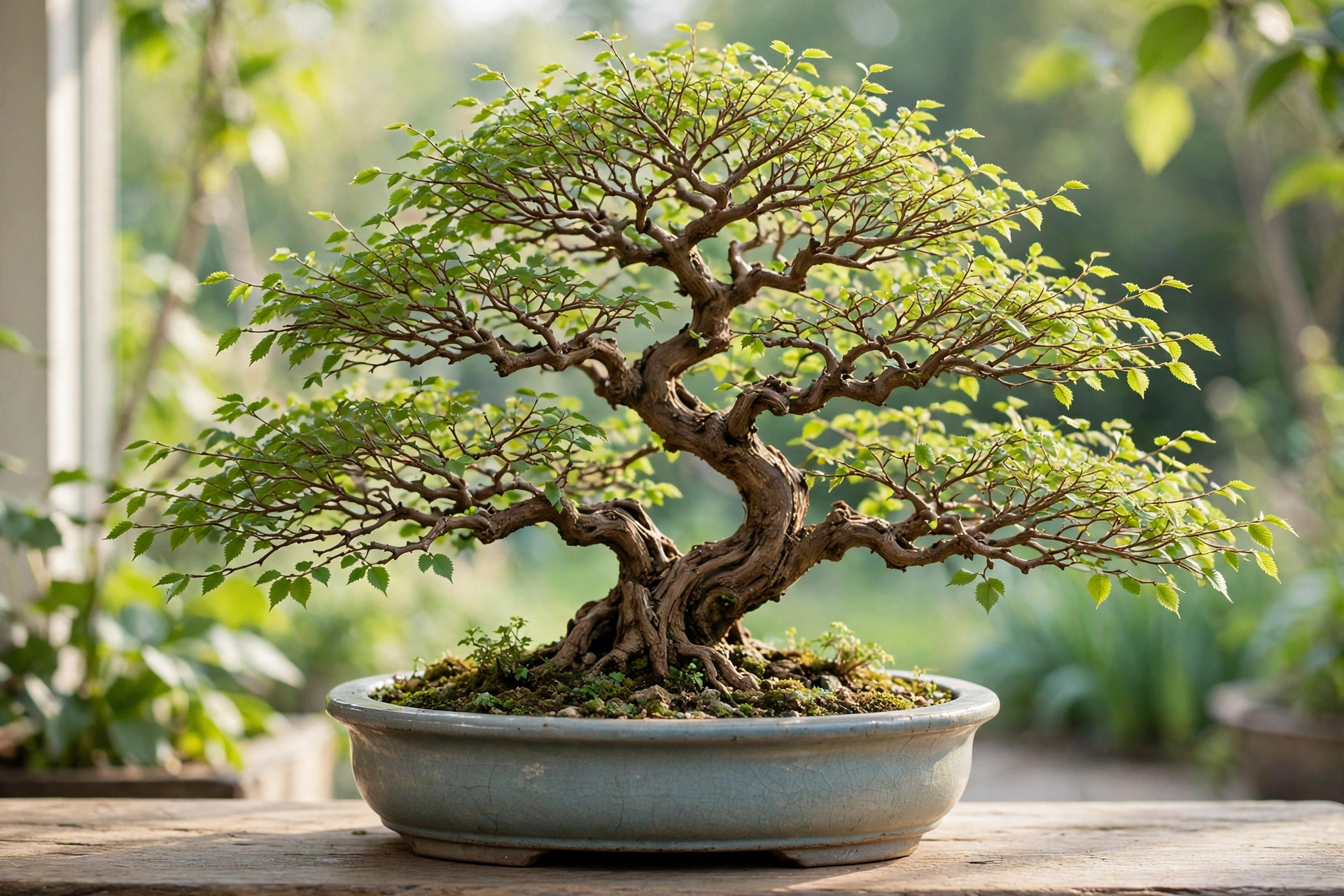
Elm bonsai care comes down to one idea: elms are outdoor, temperate trees. An elm bonsai kept outside with plenty of light, good airflow, and consistent moisture will reward you with fine branching, small leaves, and steady growth. Kept indoors year-round, the same tree will usually weaken, drop leaves, and eventually decline. Give it a place outside and learn to read its signals rather than following a fixed calendar.
Elms are popular bonsai subjects: they tolerate pruning well, back-bud readily on older wood, and develop fine twigging quickly. Their small leaves reduce well in a pot, and the bark becomes characterful with age. This guide covers elm bonsai care in general — the shared needs of the elms most commonly grown as bonsai — noting where species or climate change the picture.
Which Elm Do You Have?
Before you settle on a care routine, it helps to know which elm you are growing. Several elms appear in bonsai; their basic needs overlap, but cold tolerance and growth habits differ.
Common Elms Used in Bonsai
- Japanese grey bark elm (Ulmus davidiana var. japonica): Small leaves and fine branching. A japanese grey bark elm bonsai needs a cold winter rest outdoors.
- American elm (Ulmus americana): Vigorous and cold-hardy; larger leaves reduce with regular pruning. Needs outdoor placement and dormancy.
- Field elm (Ulmus minor) and English elm (Ulmus procera): European species for temperate regions; respond strongly to pruning.
- Siberian elm (Ulmus pumila): Very hardy and drought-tolerant once established; grows fast, so prune regularly.
The Chinese elm (Ulmus parvifolia) is a separate case: semi-deciduous, tolerant of warmer conditions, and sometimes kept indoors in warm climates. It has its own guide on this site (see below), so this page focuses on the temperate elms above.
Elm Bonsai Outdoor Placement and Light
Elm bonsai trees are outdoor trees. They need full sun for much of the day — ideally at least six hours — to keep their leaves small, their internodes (the gaps between leaves) short, and their growth compact. In very hot climates, morning sun with some afternoon shade works well; in cooler climates, full sun all day is usually fine.
Good airflow also helps: elms in still, humid air are more prone to fungal problems, while a breezy, sheltered spot — a bench against a wall, for example — lets foliage dry without dehydrating the pot.
Bringing an elm indoors for a day or two is fine; keeping it indoors year-round is not. Indoor light is far weaker than outdoor light, and the lack of seasonal temperature change disrupts dormancy. A temperate elm that never experiences winter will weaken, grow leggy, and become more vulnerable to pests. In very cold winters, protect it outdoors instead (see below).
Elm Bonsai Watering
Elm bonsai watering is about checking the soil, not following a schedule. How often your tree needs water depends on the season, the weather, the pot size, the soil mix, and how much foliage it carries. A tree in full leaf on a hot, windy day may need water daily; in early spring, only every few days.
Check the soil before you water: push a finger or a wooden chopstick about a centimeter into the surface. If it feels dry, water thoroughly until water runs freely from the drainage holes, then let the pot drain completely. If it still feels damp, wait and check again later. Never leave a bonsai standing in a saucer of water: elm roots need oxygen as well as moisture, and waterlogged soil encourages root rot.
Water in the morning when you can, so foliage dries during the day, and use a fine watering can so you do not wash soil out of the pot. In hot weather, check the soil twice a day. After repotting, keep the soil evenly moist while new roots establish. Reduce watering as growth slows in autumn, and water sparingly in winter — repeated drying causes leaf scorch and dieback of fine branches.
Soil, Feeding, and Repotting
Elms are not fussy about soil, but they need a mix that drains freely while holding enough moisture for the roots. A common choice is a granular, open mix — akadama (a granular fired clay used in bonsai soil) with pumice and a little lava rock — that drains quickly and keeps air around the roots. In hotter, drier climates, a top dressing of sphagnum moss can help retain moisture. Avoid heavy garden soil: it compacts, drains poorly, and suffocates roots.
Feed your elm while it is actively growing, from spring through late summer, using a balanced bonsai fertilizer according to the product label. Young trees in development can take a little more feed; older, refined trees need less, because heavy feeding produces long internodes and large leaves. Never feed a weak, sick, or freshly repotted tree.
Repot a young elm every one to two years and a mature tree every two to three years, in early spring just as the buds begin to swell. Remove the tree from its pot, comb out the outer roots, trim back the longest ones, and replace the old soil with fresh mix. After repotting, shelter the tree from strong sun and wind for a few weeks.
Elm Bonsai Pruning and Shaping
Elms respond well to pruning. The basic approach is simple: let shoots grow, then cut them back to shape.
During the growing season, pinch or cut new shoots back to one or two leaves once they have extended to several leaves. This keeps the silhouette tight, encourages back-budding (new shoots forming on older wood), and gradually reduces leaf size. Work through the tree regularly rather than letting it grow wild for months.
Larger structural cuts — removing a heavy branch or changing the design — are best done in late winter or early spring, while the tree is still dormant or just breaking bud. You can see the branch structure clearly then, and the tree heals quickly as growth resumes. Use sharp, clean concave cutters so the wound heals flat.
Elm branches are flexible when young and become brittle with age, so wire young growth and avoid bending thick, old branches sharply. Apply wire at roughly a 45-degree angle, snug but not tight enough to bite into the bark, and check it every few weeks — elms grow fast, and wire left on too long will scar the bark. Remove it as soon as the branch holds its position, or as soon as it begins to bite.
Winter Dormancy and Cold Protection
Temperate elms need a cold winter rest. During dormancy, growth stops, leaves fall, and the tree conserves energy for spring. A tree denied this rest gradually weakens.
Hardy species like American and Siberian elm tolerate severe cold well; Japanese grey bark elm and field elm are also cold-hardy but benefit from protection during extended deep freezes, since roots in a small pot freeze more easily than roots in the ground.
For winter protection, move the tree to a sheltered spot — against a house wall, in a cold frame, or in an unheated shed — once hard frosts arrive; insulate the pot with mulch or bury it in the ground up to its rim; water sparingly, just enough to keep the roots from drying out; and keep the tree out of drying winter wind. Bring it back into full sun gradually in spring. Do not bring a dormant elm into a heated room: warmth breaks dormancy early, and the soft new growth is damaged when it goes back outside.
Pests and Diseases
Elms are generally sturdy, but watch for aphids on soft spring growth, scale insects on branches, and spider mites in hot, dry conditions. Check leaf undersides and branch joints regularly, especially in spring and summer. If you find pests, identify them first, then choose the least disruptive response — often a strong jet of water dislodges aphids, and pruning out a badly infested shoot removes the problem. If you use any spray, follow the product label exactly.
Fungal problems such as black spot or powdery mildew appear most often in damp, airless conditions — good airflow and morning watering help. Dutch elm disease, a serious disease spread by bark beetles, is less common in bonsai, where trees are small and isolated; a branch that wilts suddenly should be removed promptly, and if you suspect a serious disease, ask a local bonsai club or extension service for advice.
Common Mistakes
- Keeping the elm indoors year-round. Temperate elms need outdoor light, airflow, and winter dormancy.
- Watering on a fixed schedule. Water when the soil needs it, not on a set day. Check the soil first.
- Letting the soil dry out completely in summer. Repeated drying causes leaf scorch and dieback.
- Overwatering in winter. A dormant tree uses little water. Soggy, cold soil invites root rot.
- Pruning everything at once. Small, regular cuts are safer and produce finer branching than one drastic cut.
- Leaving wire on too long. Elms grow fast. Check wire every few weeks and remove it before it bites into the bark.
Frequently Asked Questions
Can I keep an elm bonsai indoors?
Not year-round. Temperate elms need outdoor sunlight, airflow, and a cold winter rest. You can bring one indoors for a day or two to display it, but it should live outside. The exception is the Chinese elm, which tolerates indoor life in warm climates.
How often should I water my elm bonsai?
As often as the soil requires, which changes with the season and weather. In summer, that may mean daily watering; in winter, only every week or two. Check the soil with a finger or chopstick first, and water thoroughly when the top layer feels dry.
Why are my elm bonsai leaves turning yellow?
Yellow leaves can have several causes: overwatering, underwatering, nutrient deficiency, or natural autumn color change. Check the soil first — soggy and dry soil can both cause yellowing. If the soil is fine and yellowing is widespread, the tree may need feeding or be stressed after repotting or heavy pruning. A few yellow leaves in autumn are normal.
When should I repot my elm bonsai?
Repot in early spring, just as the buds begin to swell. Young trees usually need repotting every one to two years; mature trees every two to three years. If water runs straight through the pot without wetting the soil, or roots circle densely at the drainage holes, the tree is due.
How do I make my elm bonsai leaves smaller?
Leaf size reduces gradually with good technique: full sun, regular shoot pruning, and a pot-bound root system all encourage smaller leaves. Do not force it with defoliation, which stresses the tree and should not be used routinely.
Conclusion
Elm bonsai care is straightforward once you accept the tree’s basic nature: it is an outdoor, temperate tree that wants sun, air, seasonal change, and consistent moisture. Place it outside, water by checking the soil, feed while it grows, prune little and often, and protect the roots in winter.
Your next step is simple: check your tree’s soil and ask whether it is getting enough light and air. Small adjustments now pay off over the whole growing season.