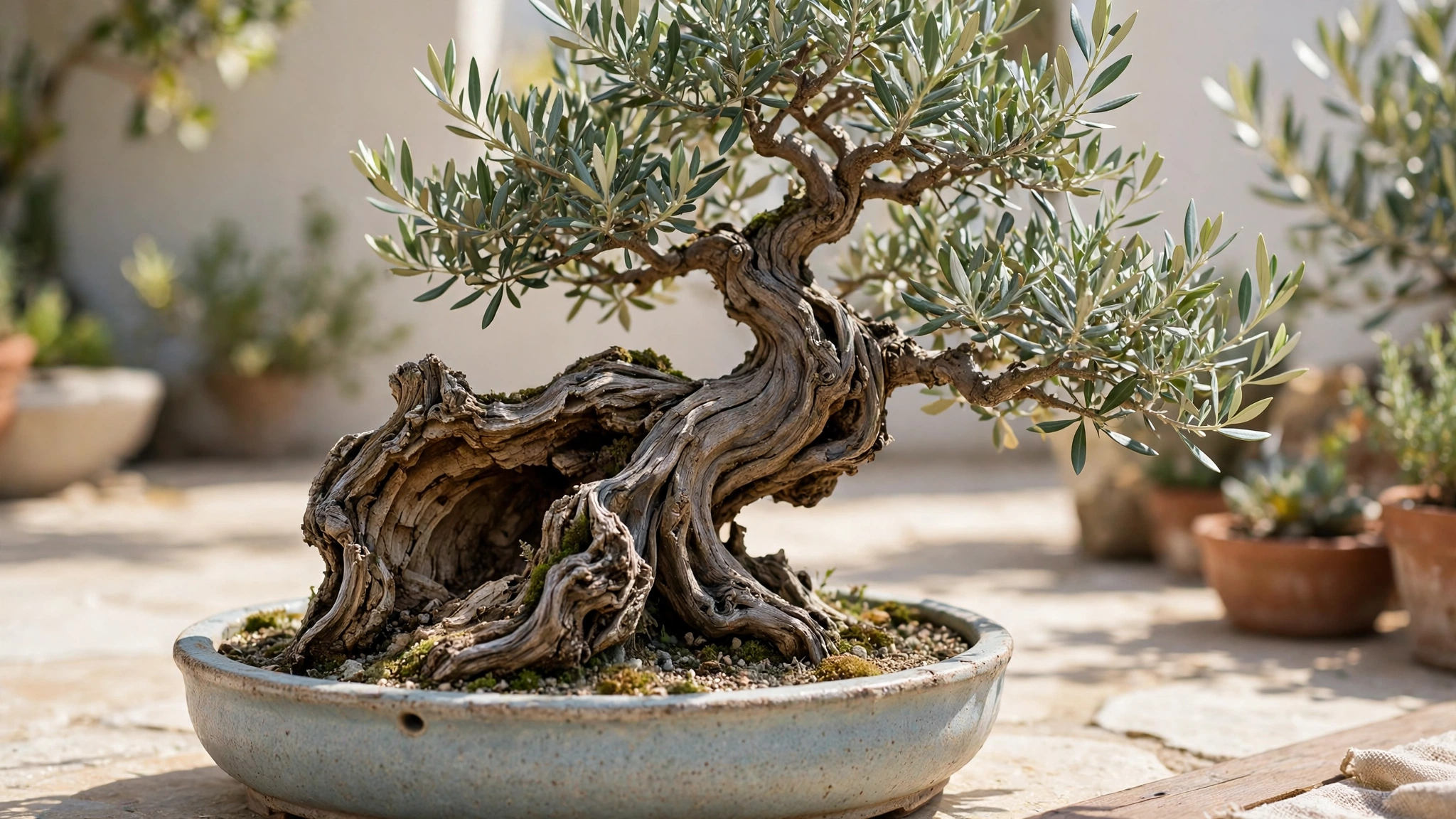
Olive bonsai care comes down to one idea: treat the tree like the Mediterranean plant it is. An olive bonsai wants strong sunlight, fresh air, free-draining soil, and a dry spell between waterings. Give it those conditions and it will reward you with a rugged, silvery-green tree.
Olives are not hardy everywhere, so your climate shapes how you care for yours.
What Makes an Olive Bonsai Different
The olive tree, Olea europaea, is a slow-growing Mediterranean evergreen, and an Olea europaea bonsai keeps that heritage. Its leaves are small and narrow, grey-green on top with a silvery underside. Old trunks develop hollows and deadwood naturally — one of the main reasons growers choose olives.
Olives also tolerate dry conditions far better than most bonsai species. Their leaves lose water slowly, and their roots prefer to dry out between waterings. But a small bonsai pot dries out fast, so “drought tolerant” never means you can forget to water.
One more point: an olive is a warm-climate tree, not a tropical one. It needs a cool winter rest and dislikes being kept warm and dark indoors through winter, yet it also dislikes deep, prolonged frost.
Sunlight and Outdoor Placement
Olive bonsai sunlight is the most important factor in daily care. Give your olive as much direct sun as you can, ideally a full day of sun or at least six hours of strong light. Strong sun keeps the foliage dense and the leaves small, which is exactly what you want in a bonsai.
Shade is the most common cause of a weak olive bonsai. A tree kept indoors behind glass, or under a roof overhang, will stretch toward the light and grow long, thin shoots with large, pale leaves. If your olive has been indoors or in shade, move it into stronger light gradually over a week or two. Give it airflow too: still, humid air encourages fungal problems.
Olive Bonsai Watering: Drought Tolerance Has Limits
Olive bonsai watering is where beginners most often go wrong, usually by watering too much. Olives hate wet feet. Soil that stays soggy rots the fine roots. The rule is simple: check the soil, then water thoroughly only when it needs it.
Check the soil with your finger or a chopstick pushed a centimetre or two into the mix. If it feels damp, wait. If it feels dry at that depth, water until it runs freely from the drainage holes, then let the pot drain completely. Never leave the tree standing in a saucer of water. Check frequency changes with the season, pot size, soil mix, and tree health, so check the soil rather than following a fixed schedule.
An olive bonsai tree in a small pot dries out faster than the same tree in a large pot, and a free-draining gritty soil dries faster than a moisture-retentive one.
Soil and Drainage
Olive bonsai need soil that drains freely and lets air reach the roots. A good mix is based on inorganic particles such as akadama, pumice, and lava rock. A typical starting mix is roughly equal parts akadama, pumice, and lava rock.
Always use a pot with generous drainage holes covered with mesh. Never use garden soil or heavy potting compost on its own — these stay wet too long and suffocate the roots.
Feeding Your Olive Bonsai
Feed your olive bonsai during the growing season, from spring through early autumn, when the tree is actively producing new shoots. A balanced bonsai fertiliser used at the label strength is a safe choice.
Reduce or stop feeding in late autumn and winter, when growth slows. Resume feeding in spring when you see fresh growth starting. Feed young trees more generously while growing them out, and more lightly once the tree is at its final size.
Olive Bonsai Pruning and Shaping
Olive bonsai pruning comes in two forms: maintenance pruning through the growing season and structural pruning in late winter or early spring, before strong growth begins. Maintenance pruning means pinching or cutting back long new shoots to one or two pairs of leaves once they have extended.
Structural pruning is for larger decisions — removing a branch that crosses another, shortening a leggy branch, or opening up the canopy so light reaches the interior.
Wiring is best done in late winter or spring, when the branches are flexible but before the main flush of growth. Olive branches are brittle, so bend gently and use thinner wire than you might for a similar branch on another species. Remove it as soon as it starts to mark the branch.
Deadwood Character: Jin, Shari, and Hollows
One of the great pleasures of olive bonsai is the deadwood. Old olives naturally develop hollows, dead branches, and stripped bark, and these features give the tree its ancient look. You can enhance this character by creating jin (a dead, stripped branch tip) or shari (a strip of deadwood along the trunk) on suitable material, Only create deadwood on a strong, healthy tree, and only on wood that is already dead or that you are certain the tree can spare.
Repotting an Olive Bonsai
Repot your olive bonsai every two to three years for a young, vigorous tree, and every three to five years for an older, slower tree. The right time is late winter or early spring, just before growth resumes.
To repot, remove the tree from its pot, comb out the outer roots gently, and trim back the longest roots — never more than about a third of the root mass in one session. Replace the old soil with fresh, free-draining mix, work it in carefully around the roots, and water thoroughly. Avoid repotting in the heat of summer or the middle of winter, and never repot a weak or sick tree.
Winter Protection and Cold Sensitivity
Olives are not fully hardy everywhere, and winter care depends entirely on your climate. In mild Mediterranean-style climates, an olive bonsai can stay outdoors all year. With light frosts, a sheltered spot against a south-facing wall is usually enough; with hard, prolonged freezing, the tree needs real protection.
Protect the tree when temperatures are forecast to fall well below freezing for more than a night or two. Move the pot into an unheated greenhouse, a cold frame, a garage with a window, or a sheltered porch. A warm living room is not suitable — the tree needs its cool winter rest, and warm, dark indoor conditions cause weak, leggy growth and leaf drop.
Protect the pot as well as the tree. Wrap the pot in bubble wrap or old blankets during cold spells, since roots in a small pot freeze far faster than roots in the ground. Water sparingly in winter — the tree uses little water while dormant, and wet soil plus cold is the combination that causes root damage. Bring the tree back outside as soon as the worst of the cold has passed; olives that stay sheltered too long miss the spring light and start the season weakly.
Olive Bonsai Care: Pests and Diseases
Olive bonsai are relatively resistant to pests, but scale insects appear regularly — small, immobile bumps on stems and leaf undersides that suck sap and weaken the tree.
Olive knot is a bacterial disease that causes rough, swollen growths on branches, usually entering through pruning wounds or frost damage, and it is more common in wet climates. The best defence is prevention: prune in dry weather, use clean tools, and avoid wounding the tree in cold, wet conditions.
Root rot is the most serious disease, and it is almost always caused by overwatering or poor drainage. The signs are yellowing leaves, stunted growth, and a sour smell from the soil. Prevention is far easier than cure: free-draining soil, a pot with good drainage, and watering only when the soil needs it. Leaf spot fungi can also appear in warm, humid conditions, showing as dark spots on the leaves; good airflow, morning sun, and avoiding wetting the foliage when you water usually keep it under control.
Common Mistakes
- Keeping the tree indoors year-round. Olives are outdoor trees, and even a bright windowsill is no substitute for outdoor sun and air.
- Watering on a fixed schedule. Check the soil first — daily watering in cool weather keeps it soggy and rots roots.
- Using heavy, moisture-retentive soil. Garden soil or rich compost stays wet too long. Use a free-draining bonsai mix.
- Leaving the pot standing in water. A saucer full of water suffocates the roots.
- Pruning hard in autumn. Do structural pruning in late winter or early spring instead.
- Leaving wire on too long. Check wire every few weeks and remove it before it bites in.
- Ignoring cold protection. Olives tolerate light frost, not prolonged hard freezing.
- Repotting a weak tree. Wait until the tree is vigorous before disturbing its roots.
Frequently Asked Questions
Can I keep an olive bonsai indoors?
Only as a short-term measure. An olive bonsai can spend a few days indoors for display, but it should live outdoors. Indoors it receives too little light and too little air movement, and it will weaken over time.
How often should I water my olive bonsai?
As often as the soil requires, which varies with the season, the pot, and the weather. Check the soil with a finger or chopstick: water thoroughly when it is dry a centimetre or two down, and wait when it is still damp.
Why are the leaves on my olive bonsai turning yellow?
Yellow leaves can mean overwatering, poor drainage, cold damage, or a nutrient shortage. Start by checking the soil: if it is constantly wet, improve drainage and water less. If the soil is fine, consider whether the tree has been exposed to frost or gone too long without feeding during the growing season.
Can an olive bonsai produce fruit?
Yes, olives can flower and fruit as bonsai, though fruiting depends on the variety, the tree’s age, and the growing conditions. Some olives need a pollinator nearby. Many growers remove the fruit to save the tree’s energy, especially on young or recently styled trees.
How fast does an olive bonsai grow?
Olives grow slowly compared with most bonsai species. Trunk thickening and branch development take years, which is why old-looking olive material is prized. Patience is part of growing olives — the tree rewards steady, correct care over time rather than quick results.
What is the best soil for an olive bonsai?
A free-draining, mostly inorganic mix — roughly equal parts akadama, pumice, and lava rock is a good starting point. Adjust the proportions to your climate: more akadama for moisture retention in hot, dry regions, and more pumice and lava for drainage in cool, wet regions.
Conclusion
Olive bonsai care is straightforward once you understand what the tree wants: strong sun, fresh air, free-draining soil, watering only when the soil needs it, and protection from hard frost. Get those basics right and the tree largely takes care of itself.
Start by checking where your tree lives. If it is indoors or in shade, move it to the brightest outdoor spot you have. Small, consistent habits are what keep an olive bonsai healthy for decades.